Here's some good news for those who have been pining for a more carrier-friendly version of Sony's Xperia Z1 flagship, at least if they're on T-Mobile. While no exact date has been set in stone yet, the smartphone has just been spotted at the Bluetooth SIG bearing T-Mobile's name, suggesting that an official launch might be coming soon.
We had a chance to get our hands on the Xperia Z1 right after Sony announced its latest flagship smartphone at the IFA trade show in Berlin early last September. The device was built to impress and it seems to get that part nailed down. It sports the usual specs that you'd expect in high-end smartphones by now, including a 2.3 GHz quad-core Qualcomm Snapdragon 800, 2 GB of RAM, a 300 mAh battery, and Android 4.2.2. It was, however, on the camera that Sony pulled out all the stops, blessing the Xperia Z1 with a 20.7 megapixel 1/2.3-inch sensor with an f/2.0 aperture and 27 mm wide angle lens, and BIONZ processing sensor. Of course, there's also the waterproof feature that Sony has added on top of all these.
It took more than a month for the smartphone to become widely available in the US, but even so, the Xperia Z1 announced by Sony in mid-October came as an unlocked variant with HSPA+ connectivity only. Now, however, it seems that another model will soon be heading for T-Mobile. A filing for a Sony Xperia Z1 device, bearing the model number C6616, was recently seen at the Bluetooth Special Interest Group (SIG). While this doesn't even give a ballpark date of launch, it does, however, give us a bit of hope that it will be happening soon. There are no news on the device's availability on other major US carriers.
Although the unlocked Xperia Z1 costs $669.99, pricing details for the T-Mobile variant are also still unknown at this point. Another unknown is whether the Xperia Z1 will be receiving an update that will bump it up to Android 4.4 directly or if the firmware will only go as far as Android 4.3 for now.
Right on cue, on November 1, Microsoft introduced a new option to its Enterprise Agreement licensing plan that "allows highly committed customers to standardize broadly on one or more key Server and Cloud technologies from Microsoft."
This new Server and Cloud Enrollment (SCE) offers users a subscription option for not just cloud, but also on-premises Microsoft software, including Windows Server, System Center, SQL Server, BizTalk Server, SharePoint Server and Visual Studio.
SCE adds new "cloud-optimized licensing options" and "the best pricing and terms," according to Microsoft's November 1 volume-price list.
To incent users to subscribe, Microsoft is providing a fiscal 2014 jumpstart promotion for SCE, which runs from November 1, 2013 to June 30, 2014. During that period, Microsoft will offer a 15 percent discount on Core Infrastructure Suite Data Center Licensing and Service Agreement (L&SA), as well as Software Assurance only to customers purchasing these products via Enterprise Volume Licensing. This price cut is available only for new purchases and will be available to customers via SCE in all customer segments worldwide.
In order to enroll in SCE, users have to make "an installed-base-wide commitment to one or more components," for three years, which means committing to full Software Assurance coverage across the installed base of a particular component. For doing so, users get 15 percent discounts for new licenses and Software Assurance purchases, plus a five percent discount on Software Assurance renewals.
Microsoft will provide SCE subscribers with new "cloud-optimized" licensing options, "simplified license management" and "the best pricing and terms." According to the datasheet, SCE is the way users can get Microsoft's lowest Windows Azure pricing, application-license mobility to the cloud and other new benefits for using System Center to manage Azure resources. Other SCE benefits include a "new subscribtion-based option" which provides greater flexibiity for retiring workloads, consolidating or migrating to the cloud, the datasheet specified.
Microsoft's co-founders are beginning to weigh in on the company's strategy and the succession plan for CEO Steve Ballmer.
Bill Gates, who remains Microsoft chairman, told the Financial Times that he plans to spend considerable time working with the next CEO. It's not clear from the interview whether Microsoft's board has asked Gates to help break in the next CEO.
A spokesman for Gates didn't respond to a request for comment.
Gates also said he's spending much more time on Microsoft business than the one day a week he planned when he stopped working there full time in 2008. The disclosures highlight Gates' continued influence as Microsoft prepares for its first chief without ties to the company's founding.
Also in the Financial Times in recent days, the head of Paul Allen's investment firm was quoted saying Microsoft's next CEO should consider spinning off the company's consumer businesses, such as the Bing online-search engine and videogame unit Xbox.
"My view is there are some parts of that operation they should probably spin out, get rid of, to focus on the enterprise and focus on the cloud," Paul Ghaffari, the head of Allen's Vulcan Capital, said at a New York event.
Several investors share those views, but Microsoft has said its businesses work better together than separate.
Ghaffari also said that if Microsoft selects a CEO without experience in the tech industry, the company should consider pairing him or her with a tech-oriented executive. That's become an issue since Ford CEO Alan Mulally emerged as a contender for the Microsoft CEO job.
Ghaffari's comments are noteworthy in part because Allen doesn't say much publicly about Microsoft, the company he founded with Gates. The day Ballmer announced his retirement as CEO, Allen issued statement saying he looked forward to a "fresh approach" at Microsoft.
A spokesman for Microsoft declined to comment. A spokeswoman for Vulcan didn't respond to a request for comment.
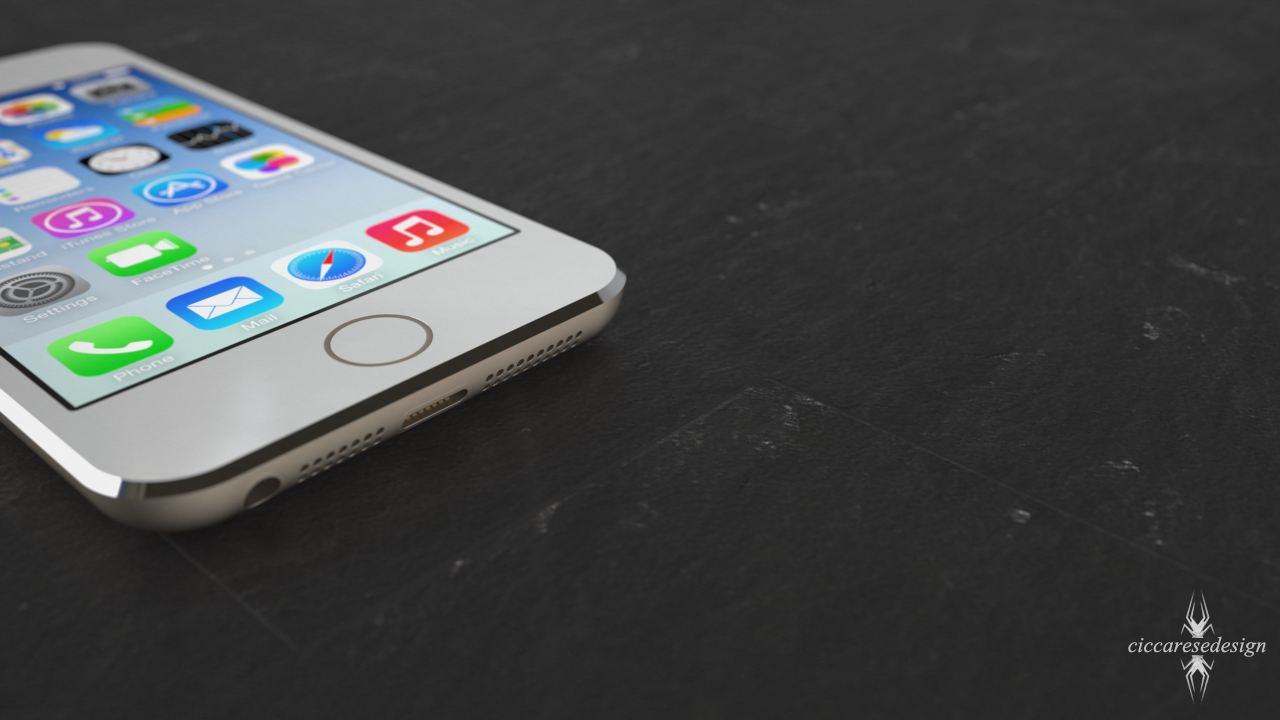
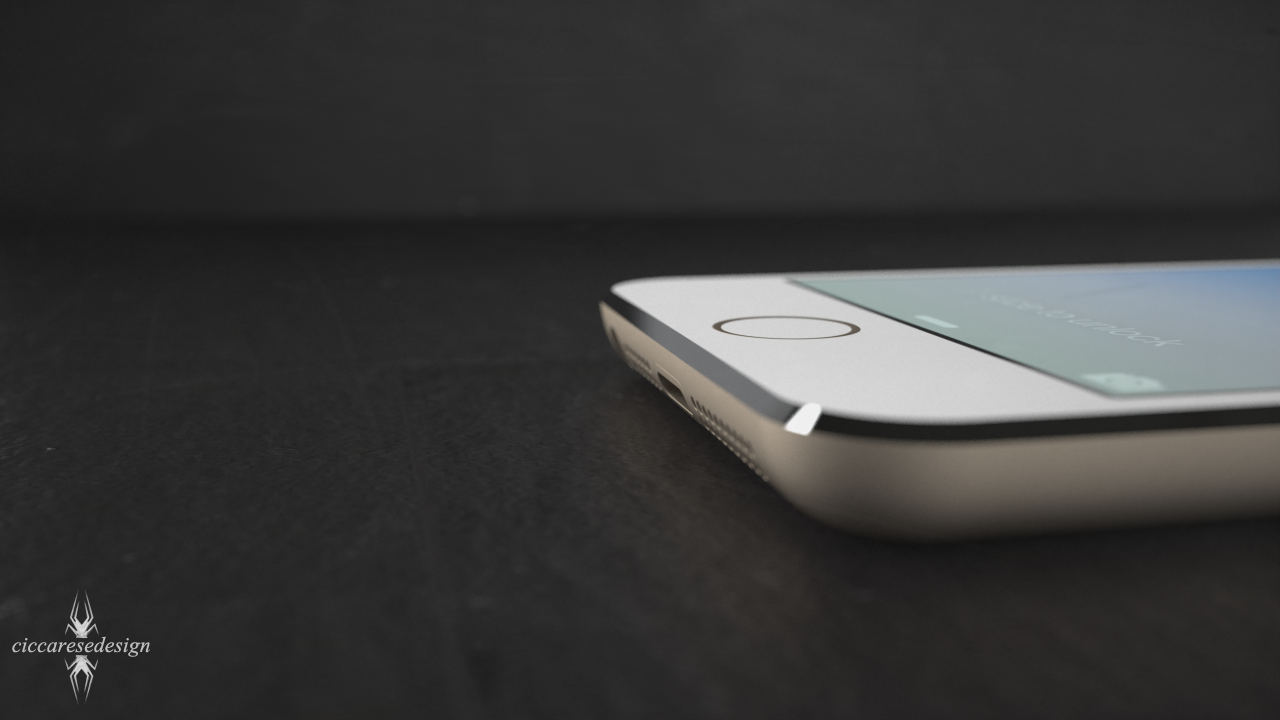
Could Apple have a sixth-generation "iPhone Air" in the pipeline? If so, one designer – Federico Ciccarese – has imagined how the anticipated product could look in an impressive new concept.
Here are a few more images from Ciccarese's concept. See what you think.
Could Apple release an iPhone Air?
Of course, the handset would feature a Touch ID-equipped Home button.
Though Apple's iPhone 5s only reached the market back in September, there have been a large number of reports discussing the Cupertino, Calif. company's next-generation smartphone, which most are calling the "iPhone 6."
Of course, though it's not so clear, it looks like the above concept proposes a 4-inch iPhone Air, which would feature a different form factor but a screen size nevertheless similar to that of the iPhone 5, iPhone 5c, and iPhone 5s.
Personally, I think Apple's iPhone is already big enough; any larger, and I'd struggle to hold on to it while using the handset. How about you?
IBM is stepping up its fight against Amazon.com around cloud computing.
In an unusual move, IBM is launching a marketing campaign Monday that names Amazon as a rival and implicitly claims that IBM is the leader in the estimated $40 billion-a-year cloud-computing market. IBM rarely mentions competitors in any of its advertisements.
"Whose cloud powers 270,000 more websites than Amazon?" asks one print advertisement that will run in some major newspapers and business magazines. "If your answer is IBM, you're among the well informed. The IBM cloud offerings also support 30% more of the most popular websites than anyone else in the world."
The campaign, which will run in print, online and outdoors, highlights the growing stakes in the battle for the cloud as companies shift more of their technology purchasing dollars to renting computing over the Internet rather than buying and maintaining their own hardware and software. IBM would not disclose how much it is spending on the campaign.
The trend is a challenge to IBM, which has made billions of dollars installing, maintaining and upgrading computer systems for clients.
IBM recently lost a high-profile fight with Amazon for a $600 million contract to set up a cloud-computing system for the Central Intelligence Agency. The CIA surprised IBM when it picked Amazon, a win that could help unlock doors for Amazon with security-sensitive government agencies and commercial clients that have long been IBM's turf.
An Amazon spokesperson declined to comment on the IBM campaign.
IBM vice president of cloud services Ric Telford said IBM is launching the campaign largely because it recently completed its $2 billion acquisition of SoftLayer Technologies Inc.
SoftLayer rents space to clients on computers the clients don't own, an area dominated by Amazon. A client, for example, might put its database or website on computer servers operated by SoftLayer rather than buy its own.
Telford downplayed the loss of the CIA contract, claiming it was just one deal of many. "IBM wins more than it loses," said Telford, citing a 10-year, $1 billion cloud computing contract it announced this August with the Department of the Interior.
In the most recent quarter, IBM disappointed investors by falling short of Wall Street revenue estimates, but named cloud computing as a bright spot. IBM it generated more than $1 billion in cloud revenue, up 70% from a year earlier, and the first time IBM disclosed its cloud revenues.
In July, IBM said in a securities filing that the Securities and Exchange Commission was conducting an investigation into how the company reports cloud revenue. IBM said it is cooperating with the agency and follows accepted accounting rules.
Teardown According to the teardown fanatics at iFixit, Apple's new iPad Air is twice as easy to repair as Microsoft's equally new Surface 2 – which received an as-low-as-you-can-go repairability rating of 1 out of a possible 10.
Actually, it would be more accurate to say that the iPad Air is only one small step away from being as fiendishly difficult to repair as the Surface 2. The low, low repairability score of 2 that iFixit assigned to Apple's slimmed-down fondleslab after their teardown is certainly nothing to be proud of.
As iFixit wrote in an email, "The changes to the new iPad are bad for repairability, but not quite bad enough to halve its score from 2 to 1. It was an extremely close call, though. We wrestled with the decision for quite a long time before reaching our conclusion."
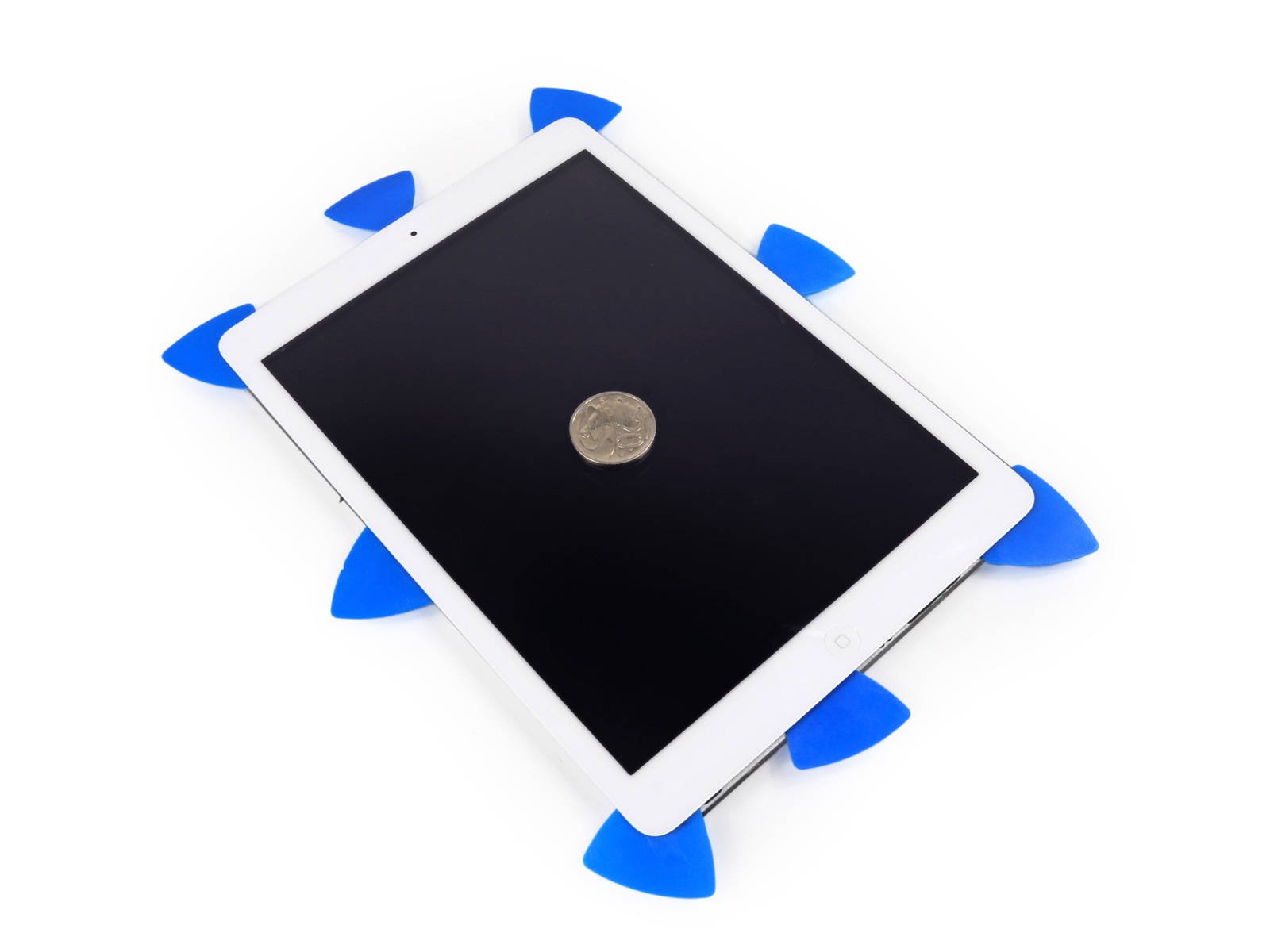
Copious amounts of adhesive was the villain in the teardown of the Surface 2, and that gunk makes its return in the iPad Air. Unlike the Surface 2, however, iFixit didn't have to break out their Chicago Heat Gun to loosen the gluey grip securing the iPad Air's case; their microwaveable iOpener heat pad was sufficient – along with the help of a handful of guitar picks.
Oz readers will I.D. that coin as an Australian 20¢ piece – 28.5mm in diameter, by the way (click to enlarge)
After popping open the case and freeing the 2048-by-1536 pixel, 264 pixels-per-inch Retina display, the two-cell lithium-polymer battery was revealed. That battery, iFixit notes, provides 32.9WHr of juice, significantly less than its predecessor's 43WHr three-cell "behemoth." Apple's tech specs, by the way, report the capacity to be 32.4WHr.
Despite this large drop in capacity, however, Apple claims that the iPad Air's enhanced efficiency will still allow for "up to 10 hours of surfing the web on Wi-Fi, watching video, or listening to music."
Why Apple understates the Air's battery capacity is an unknowable Cupertinian mystery (click to enlarge)
The amount of glue holding down the battery caused the iPad Air's Australian disassembler, iFixit reports, to send them "one, last, coherent message before strings of expletives" when attempting to remove the battery: "It's the worst battery ever," he said.
Fortunately, the iPad Air's logic board is not glued down, and removing it allowed iFixit and their pals at Chipworks to identify the chippery powering Apple's latest slab of shiny-shiny.
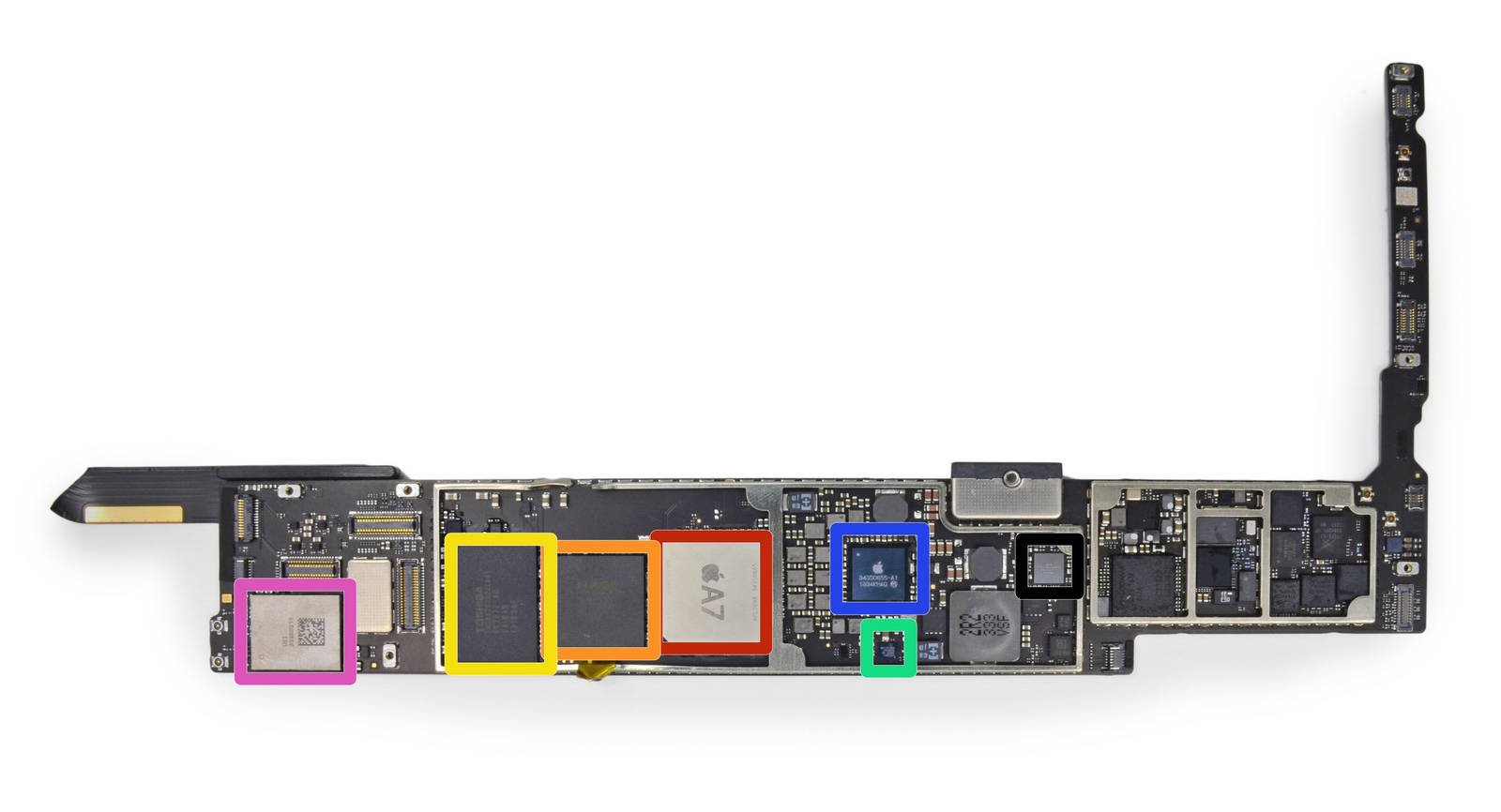
It turns out that an A7 is not an A7 is not an A7 (click to enlarge)
Interestingly, the A7 chip in the iPad Air, outlined in red and sitting next to 1GB of Elpida low-power DDR3 SDRAM outlined in orange, has a different ID number than does the A7 in the iPhone 5s – the Air's A7 is marked APL5698, while the A7 in the 5s is labeled APL0698.
Chipworks surmises that the renaming of the A7 is due to the fact that it's reported to run at 1.4GHz; the A7 in the iPhone 5s is said to run at 1.3GHz. "It's quite a hefty heat sink on the chip," they write, "so it's definitely running warmer." Alternatively, they say, the new designation could be due to a different pin-out needed to talk with the Elpida memory.
We'll ask Apple, and we're sure they'll tell us. That was a joke, by the way.
Other chips of interest include 16GB of Toshiba NAND Flash (yellow) and Apple's 338S1116 Cirrus Audio Codec (black), which iFixit says they also found in the iPhone 5c. For a full listing of all the chips, check out iFixit's teardown, which also includes 55 photos detailing the entire process.
And a painful process it was. The front panel is glued down, which increases the chances of cracking it when you attempt to remove it, for example, and the display is fastened to the front panel with foam sticky tape, which also boost the likelihood of inadvertent shattering upon removal.
All in all, the iPad Air is a bear to take apart for repair – but at least it's not a Microsoft Surface 2. ®
Google unwrapped a brand new version of its mobile software on 31 October called Android 4.4 "Kitkat", featuring an always listening intelligent search and more.
With Android 4.4 Kitkat Google has improved Android's performance, added new features and services, as well as integrated new software to support the potential for innovative new uses.
Android 4.4 continues the confectionary naming scheme
Android is now named after the Kitkat Nestle chocolate biscuit. Photograph: Denis Balibouse/Reuters
Since its inception, Google has used both an increasing numeric value, like Android 4.4, as well as names taken from famous confectionary.
It started with Android 1.5 "Cupcake", and continued through the alphabet via Android 1.6 "Donut", Android 2.0 "Eclair", Android 2.2 "Froyo" (frozen yoghurt), Android 2.3 "Gingerbread", Android 3.0 "Honeycomb", Android 4.0 "Ice Cream Sandwich" and most recently Android 4.1 "Jelly Bean".
It was long-rumoured that the follow up to Jelly Bean would be "Key Lime Pie", however in a deal with Nestle, Google named Android 4.4 after the Kitkat chocolate biscuit.
Always listening Google Now
Google Now is constantly listening out for "OK Google".
Google's intelligent digital assistant and smart search, Google Now, has been given much larger prominence within Android 4.4 Kitkat, integrating an always listening feature, which will instantly respond to voice commands triggered by the phrase "OK Google".
Instead of having to launch a separate app, your searches can be made directly from the homescreen without having to tap any buttons, just by starting your commands with "OK Google". This always-listening feature was first introduced with Google's smart glasses Google Glass, which is voice-activated by the phrase "OK Glass".
Full-screen immersion
Kitkat hides the status bar and menu bar when in full screen mode.
Google has taken steps with Android 4.4 Kitkat to make the experience of using apps like ebook readers or web browsers a much more immersive experience. It has changed the way the system-level interface elements are presented, including the status bar at the top of the screen and the Android menu buttons at the bottom.
Instead of permanently bracketing your screen with two black bars, the top notification bar is now transparent, allowing more of your homescreen wallpaper to shine through. The menu bar at the bottom of the screen can now also disappear when an app is put into a full-screen mode, allowing content to take up the full real estate of the screen.
Dragging your finger down from the top of the screen or up from the bottom of the screen now reveals the notification or menu bars when in full screen applications.
Support for lower-end phones
Android fragmentation has been a big problem for app developers ever since the operating system's inception. Essentially it means that multiple versions of Android that aren't up to date exist on various devices. While that's not an issue in and of itself, for developers it presents a massive challenge as they have to programme their apps to support multiple versions of Android – all with differing capabilities.
Google has already taken steps towards minimising fragmentation through the decoupling of its own applications and services from the operating system into separate downloadable apps. That allows users on older versions of Android to update these apps separately through the Google Play store and gain access to the new services and features.
Now Google is taking its battle with fragmentation a step further by reducing the system requirements for Android 4.4 Kitkat. In doing this Google has made it possible to run Kitkat on much lower power devices.
Low-power sensors without battery drain
Kitkat uses batch processing to reduce the battery drain while still allowing your phone to track your movements and use other sensors.
Essentially, Android will now queue up sensory input to be processed in batches, which means that the central processor doesn't need to be in a high-power state all the time to accept and process data from the phone's sensors like the GPS, accelerometers and gyroscopes.
The end result is much improved battery life, while maintaining the data logging and sensory activities that facilitate great features like Google Now, fitness trackers and location reporting.
NFC payments enhancement
Kitkat simplifies the use of NFC for payments and other functions.
Google has also taken steps to simplify and hopefully accelerate the use of near-field communication (NFC) for payments. A significant proportion of Android phones come with an NFC chip built in, which is currently mainly used for pairing accessories and Bluetooth devices.
Now Google has baked a new feature into Android Kitkat that aims to simplify the use of NFC applications for payments called "Host Card Emulation", which facilitates the connection between the applications and the NFC hardware within the Android device.
Google hopes that this new simplification within the Android software will help NFC payments, as well as other NFC uses gain traction.
Coming to a device near you soon
Following the announcement of the Nexus 5 smartphone and Android 4.4 Kitkat, various manufacturers announced that they would be updating their smartphones with Kitkat.
Google announced that previous Nexus devices, including the Nexus 4 smartphone and Nexus 7 and 10 tablet computers would get the update within the coming weeks.
HTC also confirmed that it would be updating its HTC One line of devices, including the new One Max phablet to Android 4.4 Kitkat, with the HTC One seeing the update within 90 days.
Other smartphone manufacturers are currently looking at the update, although it is known that the Samsung Galaxy Nexus will not get the Kitkat update.
• In October, Google launched its new flagship Android smartphone the Google Nexus 5 that provides high-end features at a more affordable price