The Lenovo
IdeaTab A2107A is the Chinese company's entry-level seven-inch
tablet, coming in with a lower spec than the nine-inch A2109A and
running Android 4.0. But has it got the goods to make it worth your
while?
It's on sale now for around £150.
Design
This is very much a budget tablet, but that price tag stands
favourably against the likes of the
Google Nexus 7,
Kindle Fire HD and
Barnes & Noble Nook HD -- if it can perform well enough to
compete with those fine examples of the tablet maker's art.
In its favour, it certainly doesn't feel like a budget product
-- it's sturdy and robust, and you get the feeling it could stand
up to a fair bit of ill treatment. It's on the heavy side though,
at 400g, and none too slim either at a sliver under 12mm.
Features
At one end there's a panel that slides off to reveal space for a
microSD card to expand on the 16GB memory on board, plus not one,
but two 3G SIM card slots. So you can use two separate accounts --
one for work, one for home, perhaps, or you can slip in a foreign
SIM when you go abroad to cut down on roaming costs. It won't be
for everyone, but since very few tablets offer this option, the
A2107A could find itself a bit of a captive audience.
The seven-inch screen offers a not-bad resolution of 1,024x600
pixels (we weren't expecting HD at this price) which adds up to
169ppi -- it certainly won't compete with the best for sharpness,
but it's perfectly acceptable whether you're surfing the web,
watching movies or reading ebooks.
Performance
The single-core 1GHz MediaTek Cortex processor backed by 1GB RAM
won't win any prizes (it's lower powered than the A2109A) and we
found it occasionally laggy in general use with clunky animations
between screens (thanks Lenovo, but you really shouldn't have
bothered) and some sitting around time while you're waiting for
apps to open. Our AnTuTu benchmark test delivered a score of 4,369,
which won't get anyone too excited, though it's ahead of some other
single-core budget devices such as the Disgo 9000 and way behind
the Google Nexus 7's 13,210, which has more cores and very little
price difference.
Among the many preloaded apps are Amazon
Kindle, NewsRepublic, Evernote, Norton Security, ooVoo, Cut the
Rope and Docs2Go, along with the GameTanium games store, a
BackupAndRestore facility for backing up your contacts, messages,
call logs and apps to the SD card, and Lenovo's PrinterShare app. A
decent mix, and of course there are plenty more to choose from on
the Google Play store.
The three-megapixel camera is pretty rubbish, with poor picture
quality -- you really have to work hard to get anything even half
decent out of it. Likewise the 0.3-megapixel front-facing camera
for video calls, which certainly won't show you at your
best.
Conclusion For the price, the Lenovo A2107A is a decent little
seven-inch tablet, sturdily built, running Ice Cream Sandwich and
with a decent set of features. It's a bit underpowered, and the
camera's poor, but otherwise it's a decent budget introduction to
Android tabletville. For a similar price though, the
Nexus 7 is arguably a stronger offering.
Android, Kantar says, took 49.4% of smartphone sales, a growth of 6.4% points over the same period last year. Apple's 45.9% of sales was 4.7% points down one year ago. It sources these numbers by extrapolating from data collected from 240,000 consumers annually.
And when you add those two numbers together you can see how ridiculously big the challenge is for others to get a look in. No. 3, Windows Phone, just barely breaks 3% of sales, although that's an improvement on 2.1% last year.
Also notable: Windows Phone now leads BlackBerry, which was at 0.9% of sales. Can BB10 make a difference? (Thanks @modelportfolio2003 for the link.)
Amongst many other things, today I went to the Firefox stand at MWC. It was very full of excited people talking about their new venture with some of the leading mobile operators to launch a new phone OS, aimed at the tier just below 'real' smartphones. There was much talk of openness and other ideologically correct things, and none at all about any consumer benefits. I did hear someone from Mozilla say that 'Firefox is a great consumer brand', though, which is a pretty questionable claim: the target consumers would be pushed to name ANY browser, let alone Firefox. There is a reference phone from ZTE (and also one from Alcatel I haven't seen yet): the software is slow and not especially elegant, and the device is targeted to cost $100.
50 yards away there is a half-empty stand from Haier, a second-tier Chinese OEM. Their W619 is a 2G android smartphone running Android 4, with 2 SIM slots, a 3.5" screen and an MTK chipset. It is very solid and the UI is perfectly fluid. The wholesale price is $50: 3G versions are $75.
An Apple supplier known for making iPads has been penalized by Chinese authorities for turning a nearby river in Shanghai "white" after dumping pollutants during the nation's Spring Festival holiday.
The supplier, RiTeng Computer Accessory, had wrongfully dumped waste water used for cleaning processes due to suspected staff negligence, according to a Friday statement from a parent company.
The water couldn't be used for watering crops; the waste killed all the shellfish. RiTeng also assembles for HP, Dell and Asus; it has had industrial accidents before, including explosions. Basically, China needs to take tough action against polluters like this.
Boiled down, they are: (1) BBM, even though he says that WhatsApp actually does all he needs; (2) a physical keyboard, unlike the one on his last BlackBerry which broke (not an argument for the Z10); (3) he doesn't care about apps such as Instagram. Compelling?
As a mobile solution for a digital artist I'd say the Surface Pro is a winner. Now obviously if you need Photoshop you will probably want to wait until they get their driver issues worked out. If you're a Sketchbook user (or you could be) then this thing is ready to go right now. I had some people on Twitter asking if the Surface Pro makes sense as an alternative to a Cintiq at home or the office. That one is harder for me to answer. I personally really like my Cintiq 24HD and I would not use the Surface pro at the office instead of it.
He's generally positive, but notes some downsides: heat, battery life, storage, non-adjustable kickstand angle. Still, he thinks it could replace his iPad for a number of tasks.
While the Slate 7 does perform decently, it is noticeably slower than a Nexus 7 even in basic UI navigation tasks (thank that 1.6GHz dual-core processor), and that's really just the tip of the drawback iceberg. The 1024x600 screen is terrible. Let me say what I mean by terrible: the Nexus 7's display isn't winning any awards (it's good, but by no means great), and the Slate 7's display is pretty crappy even from that point of comparison. An aspect ratio of 16:9 and unusually large bezels on the top and bottom make the Slate 7 look unusually tall, too, and I can't say I'm a fan. The unit I played with also had some weird UI scaling issues going on (everything look 'squished'). There's no NFC, no GPS, and just 8GB on-board storage.
The upshot is that HP hopes you'll buy into are the presence of a microSD card slot, HP ePrint, and a 3MP rear camera, all at a cost $30 less than the Nexus 7. Maybe for some these could be a legitimate draw, but honestly, you're likely to pay for it in the long run - who knows what HP's software update schedule is going to look like (it's running Android 4.1.1 in our hands-on), or how well this untested hardware will age (a dual-core A9 processor isn't exactly cutting-edge).
Something priced to make a retail profit is bound to struggle against something being sold at wholesale prices.
[Saturday] morning, noted rumor purveyor Sam Mobile dropped a bomb on Samsung Galaxy S fans, with a report that allegedly contains the official specifications of the upcoming Galaxy S4. The shocker is that Samsung will supposedly not be using an Exynos processors nor an AMOLED display on their 2013 flagship.
Before we go any further, note that Sam Mobile claims that, while the information comes from a "trusted insider", it's not official. It wouldn't be the first time tech sites are served fake info, so don't take everything in this post at face value.
As reported by Facebook and Apple, Microsoft can confirm that we also recently experienced a similar security intrusion.
Consistent with our security response practices, we chose not to make a statement during the initial information gathering process. During our investigation, we found a small number of computers, including some in our Mac business unit, that were infected by malicious software using techniques similar to those documented by other organizations. We have no evidence of customer data being affected and our investigation is ongoing.
Would this have been down to the same iPhoneDevSDK site that affected Facebook and Apple? (Thanks @rquick for original pointer.)
Falcon Pro was, and technically still is, one of the most popular paid Twitter clients on the platform. According to the Falcon Pro Twitter account, only 40,000 users have actually paid for the app, with the remainder presumably made up by pirated users. Apps in excess of 100,000 user tokens or 200% of their original users require additional permissions from Twitter to exceed the limit - so far, Twitter has not deemed any third-party clients on any platform worthy, with the possible exception of first-party clients and acquisitions like TweetDeck.
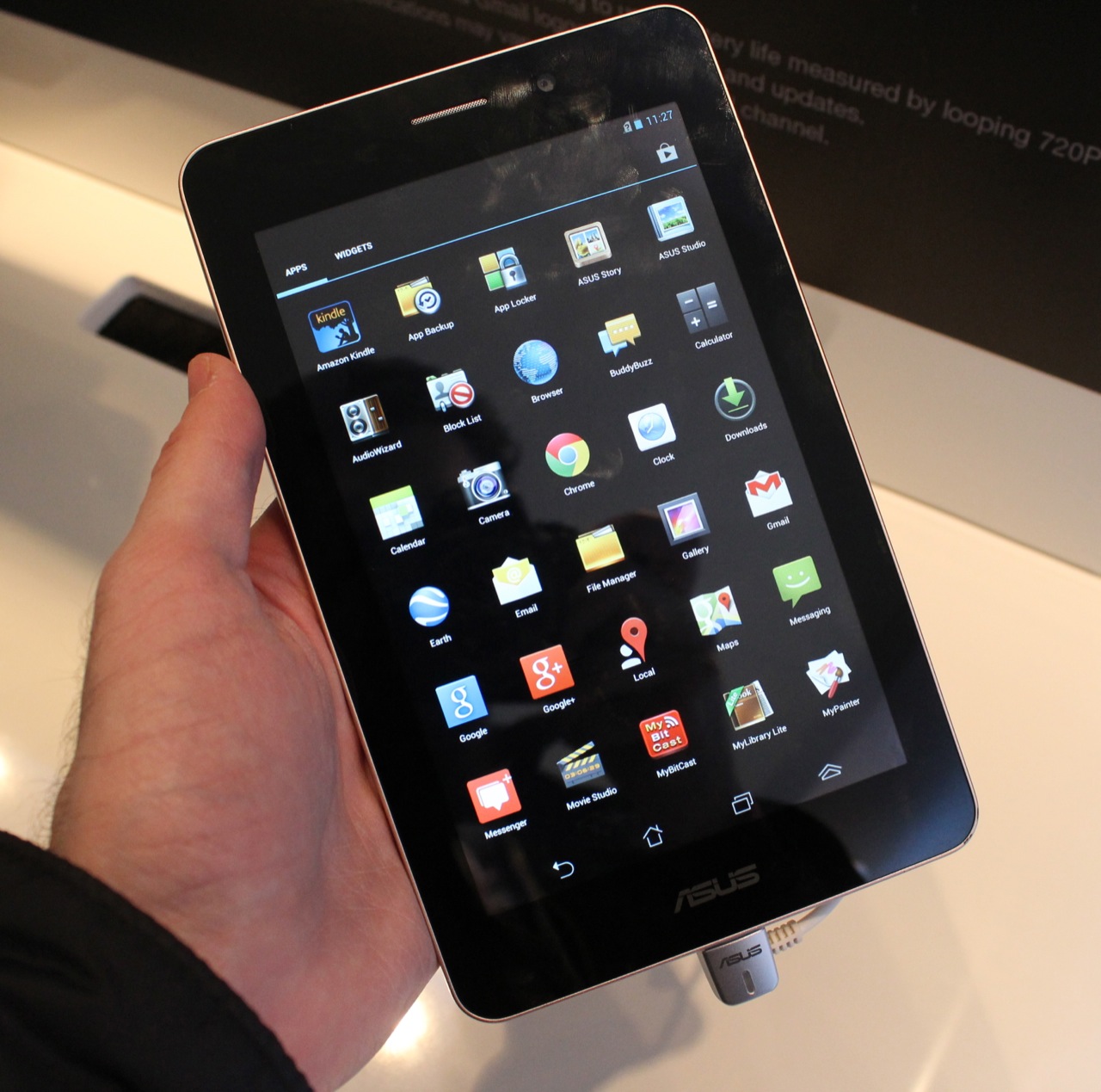
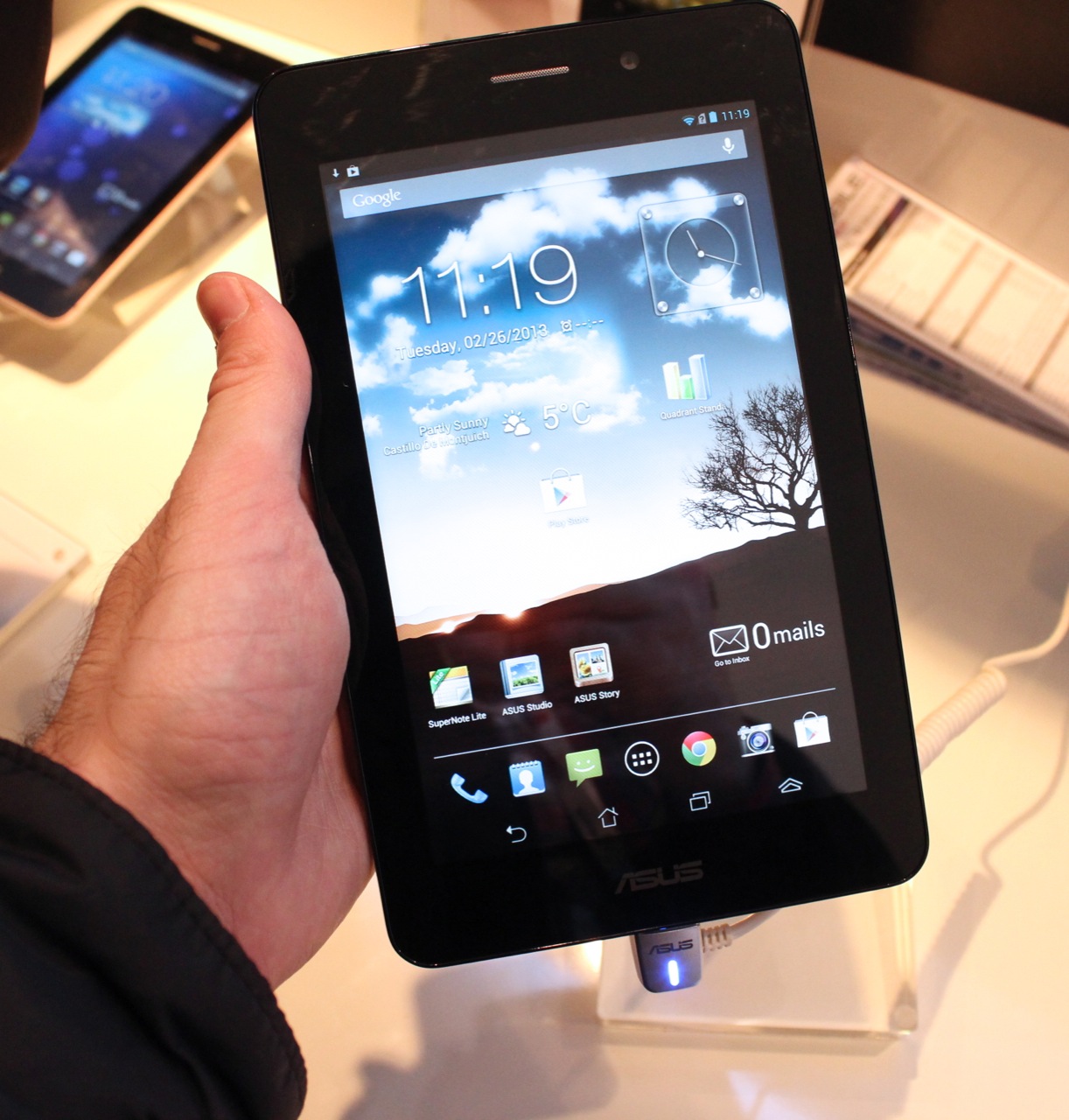
Handset makers these days seem intent on blurring the line between phones and tablets, and while there are plenty of large-screened phones on the floor here at Mobile World Congress, no one is going to the lengths that is Asus. At the company's press conference yesterday, it revealed two devices of interest: the FonePad, a 7" Android tablet that features 3G data and voice capabilities; and the PadFone Infinity, the latest iteration of their phone-and-tablet-dock concept that has been kicking around for awhile now.
We stopped by Asus' booth to log some hands-on time with both devices. Neither has been announced for the United States just yet, but they're likely to be a sign of things to come.
The FonePad, a tablet that's also a phone
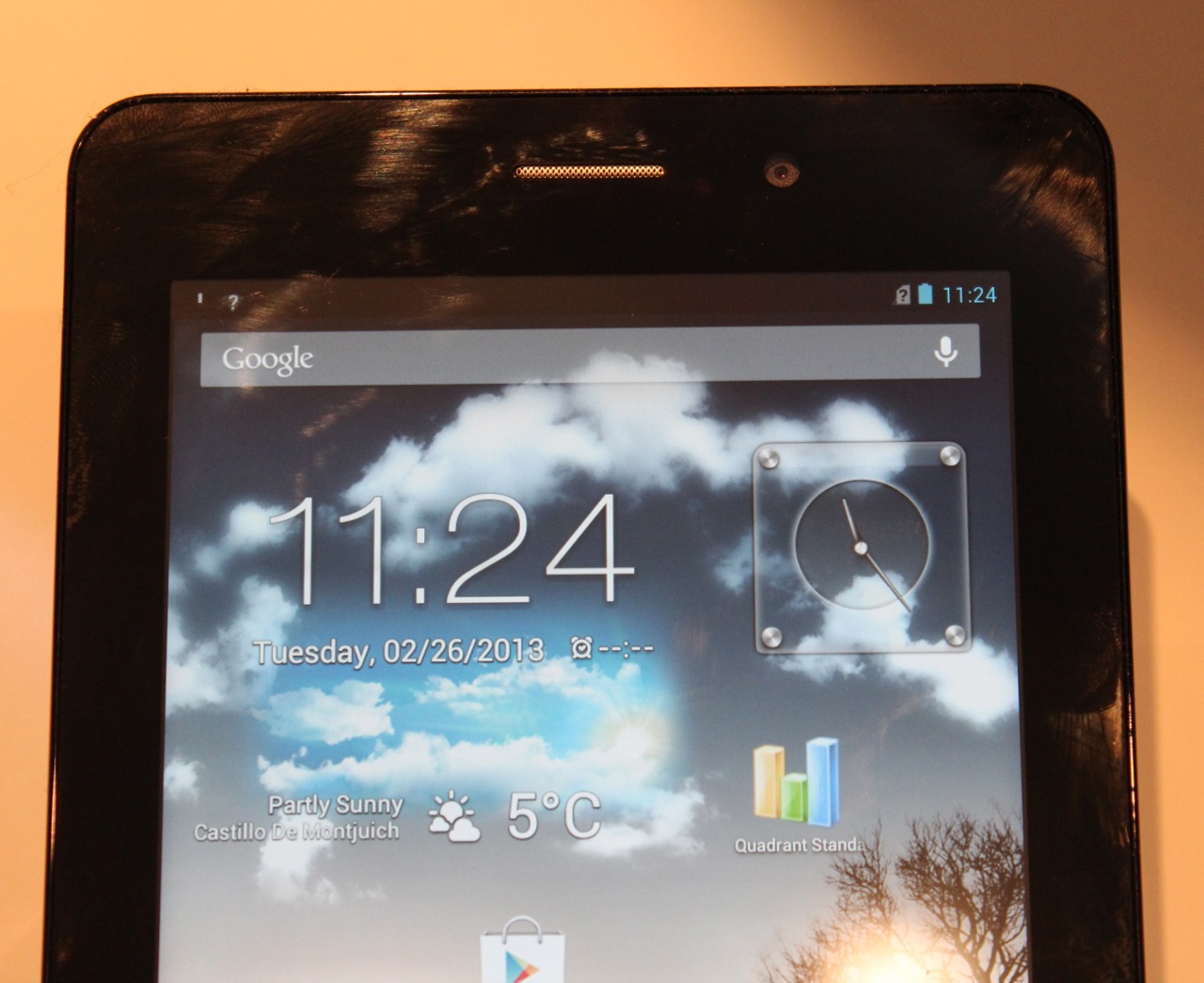
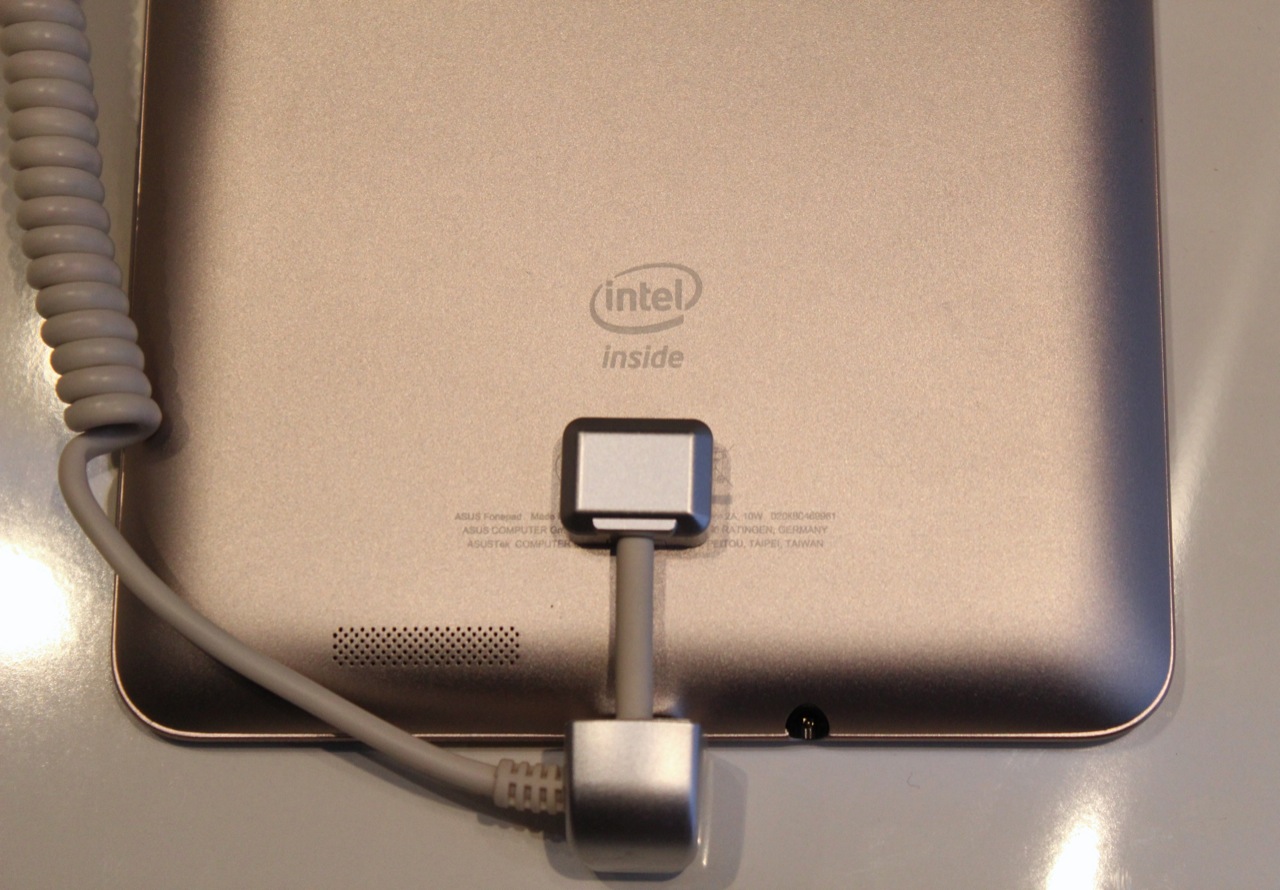
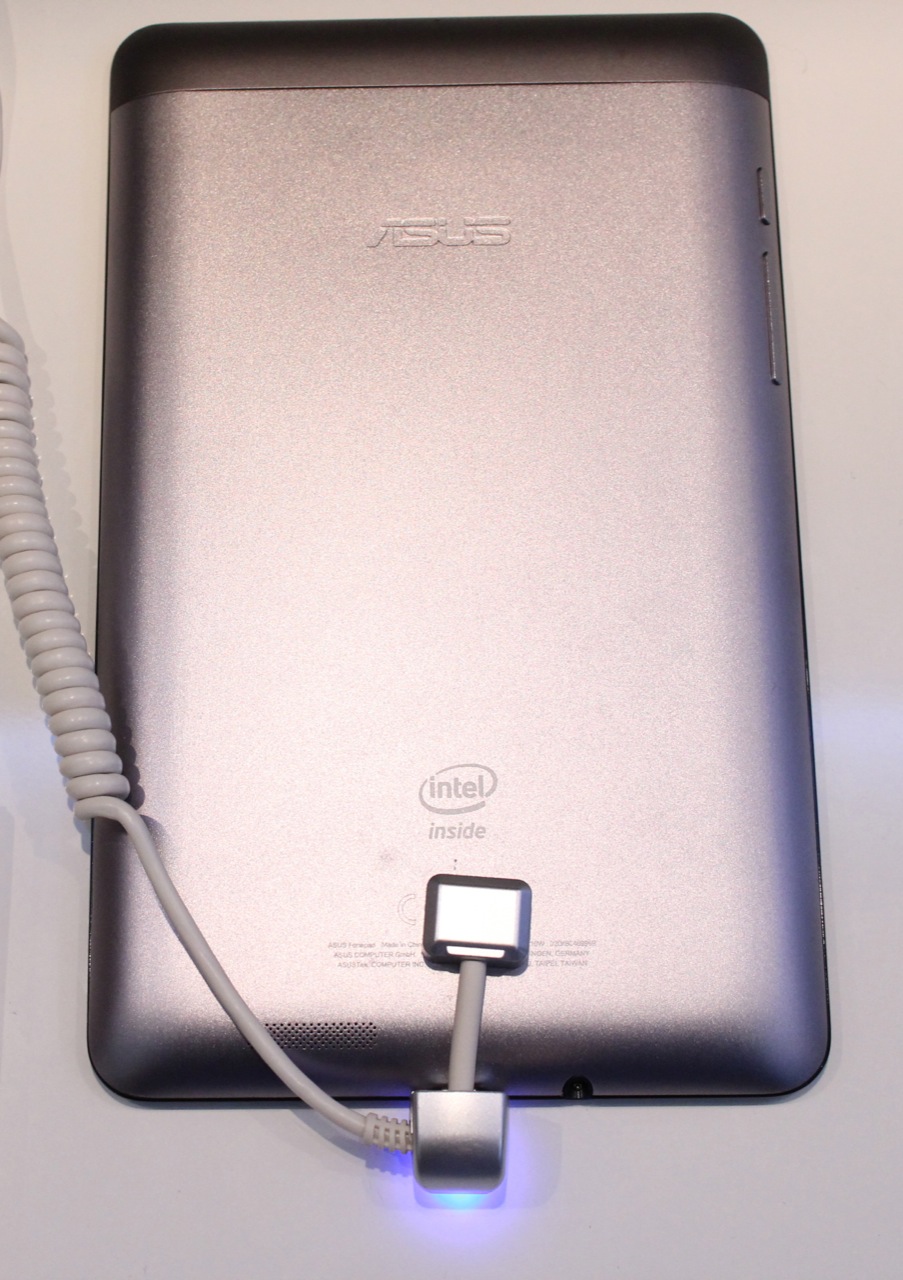
Let's start with the FonePad. On its surface, it's very much a 7" Android tablet in the style of the Nexus 7 (a comparison made all the more apt by the fact that both are made by the same company). It has a 1280×800 display and runs a lightly skinned version of Android 4.1.2—not the stock Android 4.2 experience you get on the Nexus 7, but not terribly different. Like the Nexus 7, it includes 16GB of storage and 1GB of RAM. The European model (pictured) is also missing a rear camera, something that may give you pause if you're looking at it as a potential phone replacement (the Asian version will sport a 3MP rear camera, though).
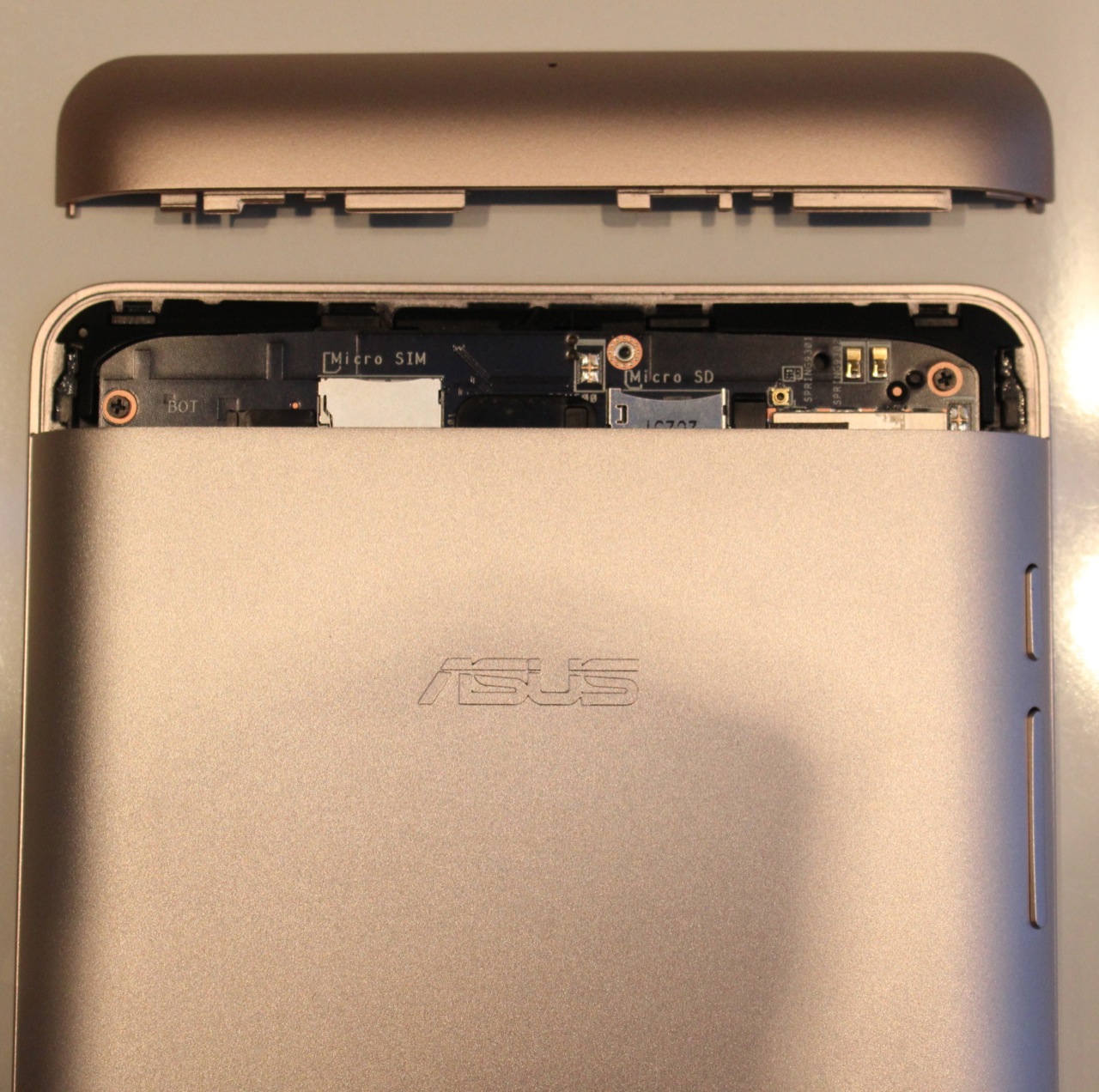
There are three differences of note. First, of course, is the device's signature voice calling capability—the top of the back case slides off to reveal a micro SIM slot (as well as a microSD slot, another difference from the Nexus 7), and once you've inserted one you can use it for data and for voice calls.
We couldn't test call quality, of course, since Asus' demo units didn't include SIMs, but we will say that it feels a little silly to hold something as large as the Fonepad up to your ear. It will no doubt be a workable solution for those who value a larger screen over all else in a phone—the ever-increasing size of smartphones seems to indicate that this demographic exists—or if you use a headset for most of your calls, but as a primary phone it strikes me as just a bit too large for comfort.
The second interesting thing about the Fonepad is that it's got Intel inside—though not, apparently, the same Clover Trail+ Atom processor we reported on yesterday. Rather, it uses the Atom Z2420 that Intel unveiled at CES last month, and while Jelly Bean seemed to run well enough on it it's certainly not Intel's fastest Atom. The Z2420 pairs a single-core 1.2GHz Hyperthreading-enabled Atom with a PowerVR SGX 540 GPU, the latter of which is even a bit slower than the GPU used in the Nexus 7's Tegra 3. It's also almost certain to be using and Intel modem—whether the older XMM 6260 or the newer 6360 isn't clear—but either way this means it won't support LTE.
And, finally, we get to the build quality—the Nexus 7 is made mostly of plastic, and while for a $200 tablet it doesn't feel terribly cheap, it's also not the sturdiest thing in the world (the back of my own Nexus 7 has been known to come loose from the front if it falls off the bed, and while it snaps back together easily it doesn't inspire a ton of confidence). The Fonepad, by contrast, has a slightly rounded, smooth metal back that feels nice to hold. Whether it stays together better than my Nexus 7 is hard to divine from using the tablet for 15 minutes, but it does feel a little better.
There's no word on US availability for the FonePad, but it should be available in Asia for $249 in March and in Europe for €219 in April.
The PadFone Infinity, a phone that turns into a tablet
Asus' PadFone product line isn't new, but the PadFone Infinity updates the hardware to bring it in line with the rest of the high-end Android competition.
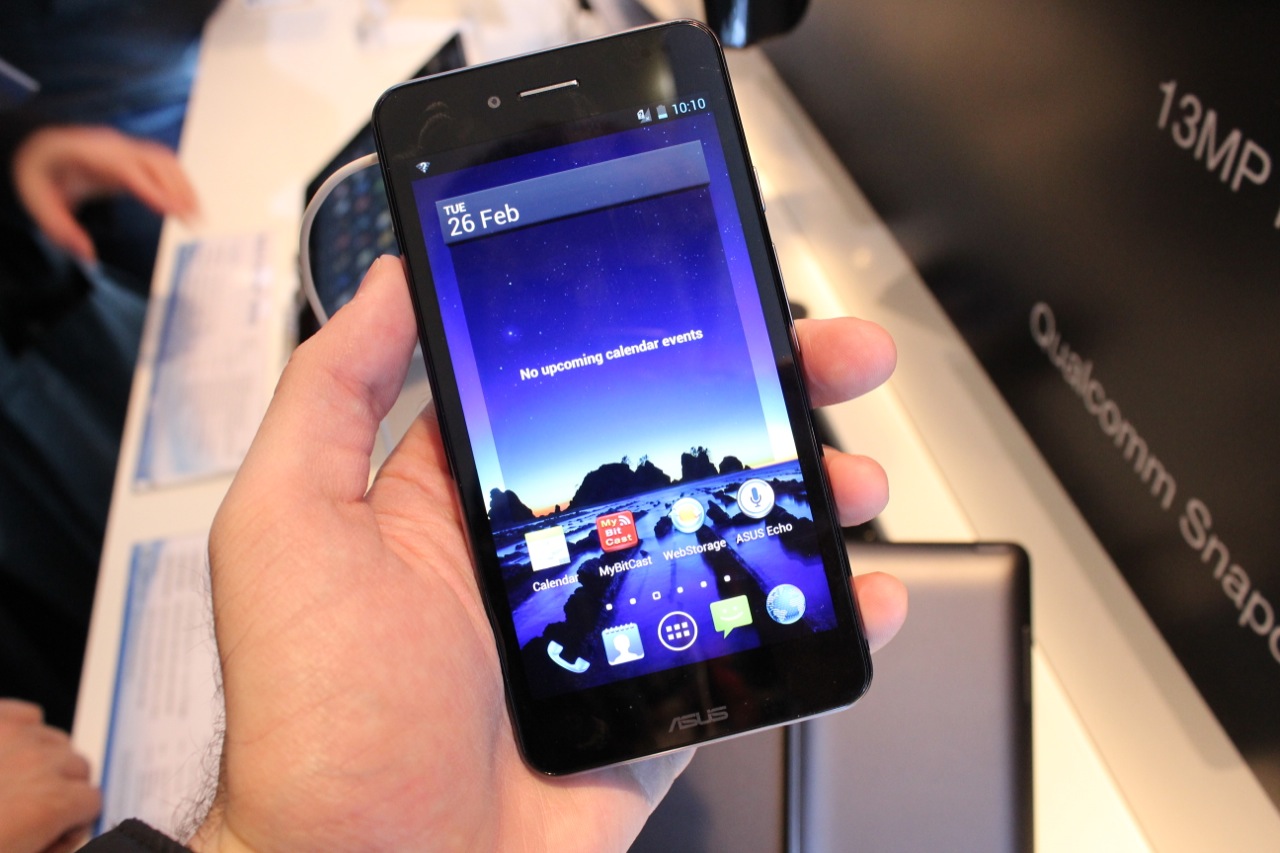
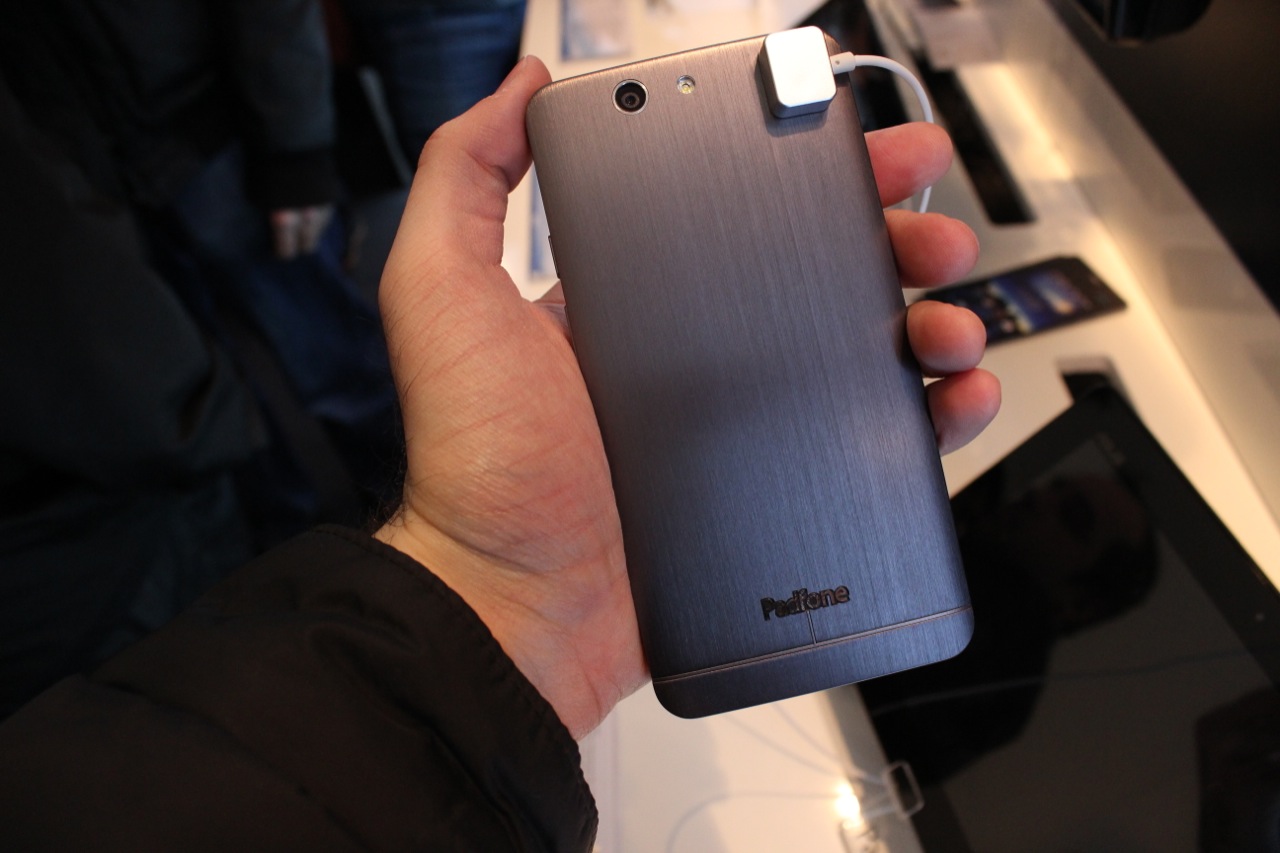
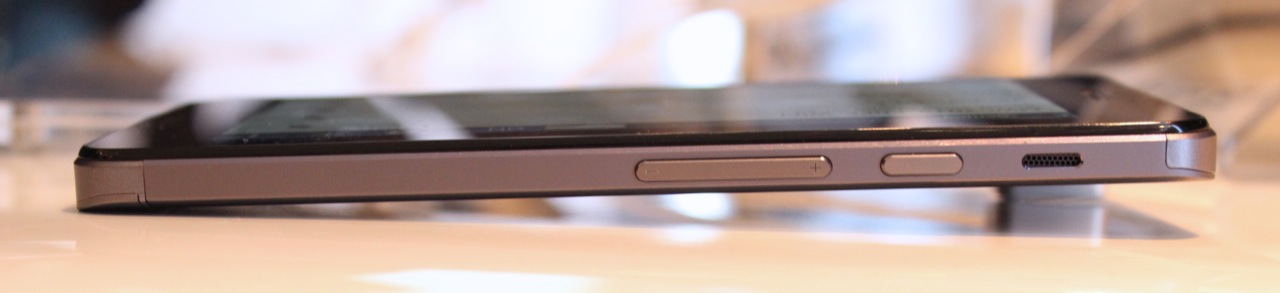
It starts with the phone, which even by itself is a relatively impressive handset. Like other high-end Android phones of late, it includes a 5" 1080p IPS display, a 1.7GHz quad-core Qualcomm Snapdragon 600 SoC, and 2GB of RAM. It's also got either 32 or 64GB of storage, a 13MP rear camera, a 2MP front camera, NFC, Bluetooth 4.0, dual-band Wi-Fi, and LTE support, all packed into a five ounce, 0.35" thick package.
The phone has a lightly curved, brushed metal back and feels pretty good to hold. We weren't able to run our standard suite of benchmarks on the phone (or perform any battery life tests, given how power-hungry some of these quad-core 1080p phones are), but Asus' skinned Android install ran smoothly and without issues (Asus' presentation and spec sheet lists Android 4.2, though the devices themselves appear to be running Android 4.1.2—we'll give Asus the benefit of the doubt and assume the update will be available by the time the device launches). By itself it would be a fairly impressive high-end Android phone along the lines of other high-end Android phones we've been seeing lately.
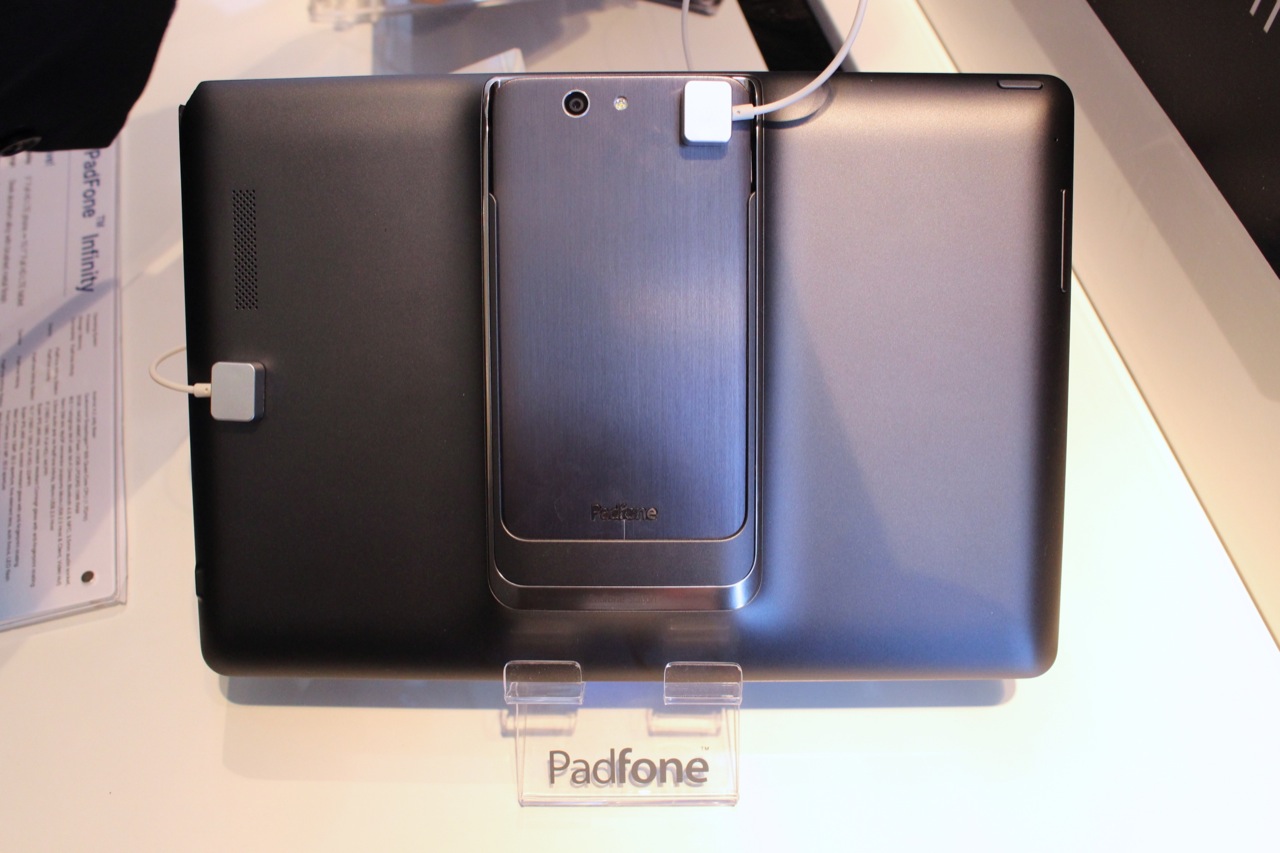
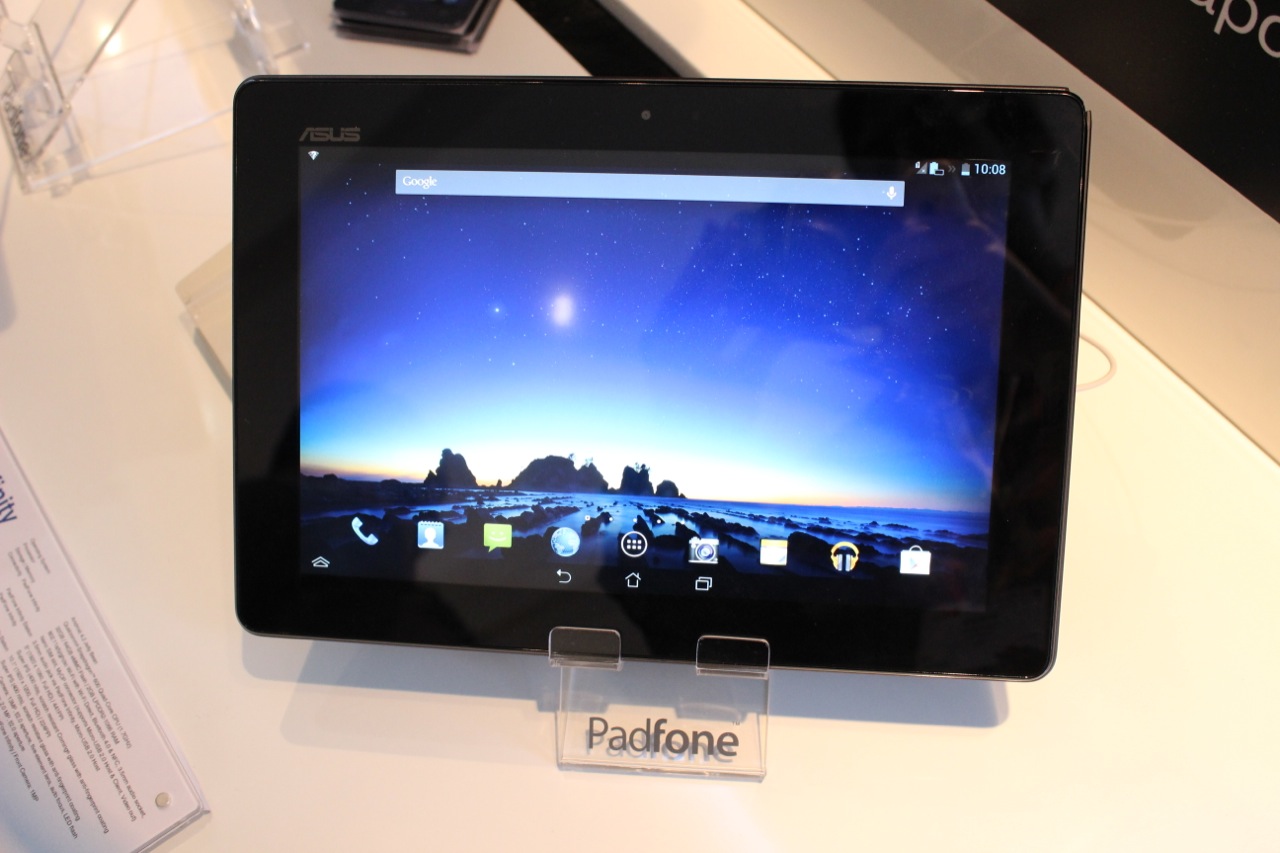
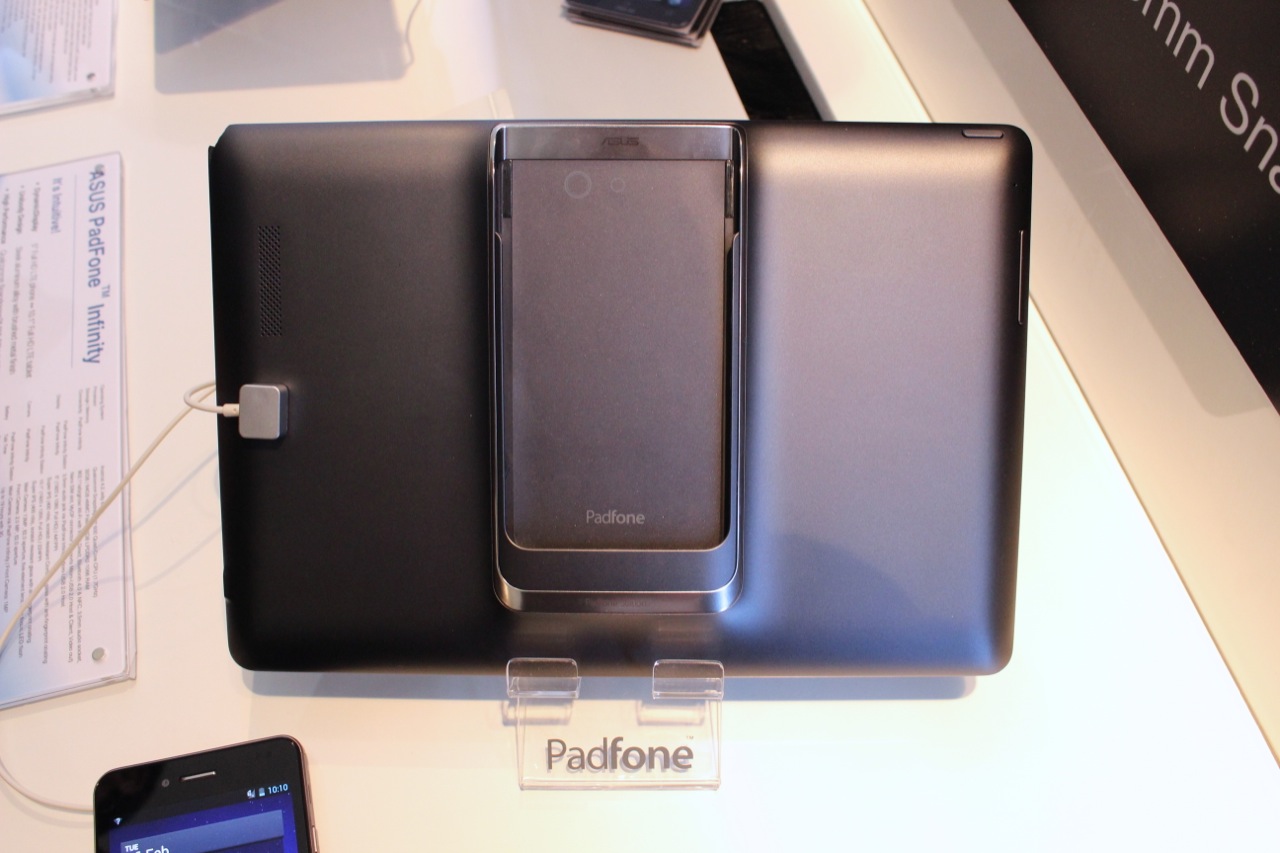
Where the PadFone Infinity differs, of course, is in its tablet shell. I call it a shell because there's really not a lot in it—a 10.1" 1920x1200 display, a battery that can recharge and extend the phone's talk time, a front-facing 1MP camera, and some extra internal antennae. All of the heavy lifting is done by the phone—the tablet uses the same storage, internals, connectivity interfaces, and camera, and therein lies the appeal of the device. If you have issues keeping your phone and tablet in sync with one another, just fold them into the same device.
Depending on how you hold your tablet, the PadFone in tablet mode can be a bit uncomfortable—the back of the tablet is a nice, smooth metal, but there's a bulge in the center for the cradle where the phone is inserted that might get in your way if you hand reaches the center of your tablet to hold it. The phone does seem to fit pretty securely in the tablet-dock, though, and while there's no physical latch or anything that keeps the phone in place, we wouldn't be too worried about it falling out on accident.
There are two potential issues with the PadFone, which launches in Europe in April: the first, for many, will be its price tag of €999, or just over $1,300—roughly commensurate with what you'd pay for an unlocked iPhone and an iPad; that combination would include a whole lot of hardware that Asus simply doesn't have to pay for in the tablet part of the PadFone.
The second is the downside of having two devices in one—if you find one of the two to be in some way deficient, you've got to replace both to get something new. There are probably people for whom this model make sense, surely, but at least for my part I can say that I'd rather replace each on its own schedule.
As with the FonePad, we don't yet have information about US availability for the PadFone, but we'll keep our ears to the ground.
What's in a name?
We'd be remiss if we didn't say something about the names. While at first glance the FonePad name makes sense as a play on the existing PadFone brand, after some time spent writing and talking about them it's far too easy to get them confused—if you mention PadFone or FonePad to someone, it's a near-certainty that you'll have to clarify whether you're talking about the phone-tablet or the phone-and-tablet dock, since the person being spoken to is unlikely to know which you mean without additional context (and there's a chance that the speaker may be mixing them up anyway).
This will undoubtedly be a minor point for some, but the potential for confusion strikes us as high—staying with the existing PadFone name and tacking a "7" onto the end to refer to the screen size may have been a safer approach. In either case, Asus continues to put together interesting hardware—both of these products will undoubtedly serve niches rather than a mass market, but they should serve those niches well.
Microsoft is in talks to invest up to $3bn (£1.9bn) in the private equity buyout of personal computer maker Dell, according to a US report.
As the world's third largest PC manufacturer, Dell is one of the biggest distributors of Windowssoftware and its future is tightly bound with Microsoft's.
The software giant is in negotiations with the company's chief executive, Michael Dell, and buyout firm Silver Lake about helping finance a deal to acquire the company, currently valued at almost $23bn, according to the CNBC network.
Microsoft has yet to make headway against Apple and Google's Android operating system in the smartphone market, and sales of portable devices are beginning to stifle the PC market, threatening its core business. The group is said to be considering spending some of its $66bn cash reserves on an investment in Dell of between $1bn and $3bn, in a deal which could be announced by the end of the week. The commitment could take the form of a loan rather than an equity stake.
Global sales of PCs fell by 13m last year, the first drop since the dotcom crash produced a temporary dip in 2001. The software group has taken stakes in other companies in the past, including Apple and, more recently Facebook. Juliette Garside
A number of staff at UK studio Lionhead have his afternoon been told that their jobs are in danger.
It is hoped that at least some of those affected will be found new roles within the wider Microsoft Studios network. The exact number of staff affected remains unknown.
"Following the completion of Fable: The Journey, Lionhead Studios has begun work on its next projects," a statement released to MCV explains. "As is common in the games industry, a smaller headcount is needed as projects kick-off and ramp up as full-production gets underway.
"At this time a small number of positions have been identified as at risk of redundancy and the affected employees were notified today. We are working very closely with those people during this difficult time, to help them explore alternative opportunities within Microsoft – including new roles at Microsoft Studios which is growing in the UK and actively hiring across all locations, including Lionhead, Rare, Soho Productions and our recently announced new studio in London.
"There is a thoughtful and fair consultation process for all employees to ensure they have the best possible chance of finding a role inside Microsoft Studios. We are working closely with the affected employees during this difficult time, and helping them to explore opportunities.
"We do not have an exact number to share but by the end of 2012 these reductions will account for less than 10 per cent of the overall headcount at Lionhead. More importantly, we expect to add over 100 people to Microsoft Studios in the UK over the course of the year to June 2013."
Microsoft last month announced the formation of a brand new Soho-based development studio in London. It's being headed up by former Rare production director Lee Schuneman.
Whether Santa brought you a new Kindle Fire HD or your old one just needs the dust blown off, holiday down time is the perfect chance to side-load several of Google's apps onto your Amazon tablet without rooting the device. As you may know, the Kindle Fire tablets do not come with the standard suite of Google applications made available to other Android tablets. That can be a bit of a bummer for users who are particularly attached to their Google apps.
Reddit user InnerManRaptor came forward to save the day, posting a step-by-step account on how to side-load Google apps onto the Kindle Fire HD. It includes fiddling with the Kindle's settings to make side-loading possible, then downloading the APK (Android Package File) files onto your desktop and carefully transferring them over to the device. The APK includes Currents, Maps, Street View, Google Talk, YouTube, and Gmail, though not all the apps work perfectly. While YouTube, Gmail, and Currents work well, Google Maps cannot pinpoint the Kindle Fire HD's location from Wi-Fi as it would on a standard Android device. Additionally, these apps are not the same versions featured with the latest iterations of Android Ice Cream Sandwich and Jelly Bean. Still, if you ache for the ability to access your Google accounts on your Kindle tablet device, this is a worthy middle-ground without having to trade in the tablet for a Nexus device.
More information about side-loading Google applications on to a Kindle Fire HD is available in the intrepid XDA Developers forums. If you're also interested in Google Play functionality on your Kindle Fire HD, the folks at Android Authority have a helpful how-to on tweaking the System folder in order to get the Play store working on the 7-inch Fire.
Disclaimer: As always, use caution before downloading files from an unknown source.
Microsoft's Windows 8 platform certainly has its fair share of detractors, but perhaps the most vocal so far has been internet entrepreneur and MIT processor Phillip Greenspun who recently likened the OS to a 'dog's breakfast.'
Greenspun panned almost every aspect of Microsoft's new software, noting that Microsoft had four years to study Android and more than five to examine iOS, but still couldn't build a usable tablet experience, reports BGR.
Clearly not impressed by what Microsoft has come to the table with, Greenspun even went as far as saying that Windows 8 would be the perfect Christmas gift for somebody that you hate.
'The only device that I can remember being as confused by is the BlackBerry PlayBook,' added Greenspun on his blog.
'Suppose that you are an expert user of Windows NT/XP/Vista/7, an expert user of an iPad, and an expert user of an Android phone… you will have no idea how to use Windows 8.'
According to recent stats, Microsoft will sell less than 1 million Surface RT tablets this year. Microsoft CEO Steve Ballmer said sales had been 'modest' but this is still an exceptionally low-figure.
Nonetheless, Microsoft has confirmed that Windows 8 has been installed 40 million times since its release, which isn't too bad at all.
Personally speaking, I don't mind Windows 8 having used it for a good couple of months on my main PC at home. Yes it does have its nuances but they're nothing compared to Windows RT, the ARM-specific version of Windows 8 that's about as useful as a one-legged dog.
So, are there any upsides to using Windows 8 in Greenspun's view?
Yep, just one: 'some of the supplied apps [notably Bing Finance] are wonderful.'