Tuesday, 30 October 2012

Apple iPhone 5 to retail in India starting Rs 44500 - Business Today

We have already confirmed that Apple iPhone 5 will be launched across India on November 2. We now have some details about the pricing as well.

BGR India has posted that Redington - one of the two official distributor partners for Apple products in India - has confirmed that the iPhone 5 will be priced starting Rs 44,500 for the 16 GB variant. The iPhone 5 32 GB version will retail at Rs 52,500 while the 62 GB version will be priced at Rs 59,500.

Since the iPhone 5 will be available across the country, those interested can also book the device before the launch . Online shopping sites and retailers like Infibeam and Saholic have starting taking pre-orders for the iPhone.

Infibeam.com has listed the iPhone 5 - 16 GB, 32 GB and 64 GB, all black variants for pre-order with the note - 'This item will be released on 2 November 2012' and 'Ships within 1-2 business days from the release date'.

Similarly, Saholic has put up the white and the black variant up for pre-order but it will take longer to deliver the iPhone. The website states 'Receive in 8 business days'.

Even Airtel has started taking pre-orders for the 16 GB iPhone 5 and says it will be available from the November 11, ships in 15-16 days.

The iPhone 5 features a 4-inch capacitive touch display, runs on iOS 6 and has got the A6 chip onboard. Apple iPhone 5 measures 7.6 mm thin and weighs 112 grams, 18 per cent thinner and 20 per cent lighter than iPhone 4S.

Pandora app for Android, iOS gets major redesign - NDTV

Internet radio company Pandora is adding more functionality to its mobile apps showing lyrics and artist information and making it easier to share self-crafted stations with friends as companies intensify efforts to lure mobile advertising dollars.

Pandora is essentially bringing the features of its website to users of its apps for Apple and Android mobile devices. The app for iPhones is being released Monday, while an Android version is expected to follow soon. Pandora also said it is releasing a version for Microsoft's Windows Phone 8 early next year. It will allow ad-free listening for a year with the Windows app.

Mobile use of Pandora's streaming service is growing quickly. In the quarter that ended in July, mobile listening nearly doubled from a year earlier and made up more than 75 percent of its 3.3 billion listener hours.

Pandora is the leader in free online radio, where listeners can pick genres or styles of music but not specific songs or albums. It has 175 million registered users, including 58 million who use it in a given month. It claims a 73 percent share of the market for free online radio.

Pandora competes for listeners with services such as Clear Channel's iHeart Radio and has apps on phones, tablets, computers and car stereo systems. Apple is the leading online seller of song and album downloads, while a whole host of paid subscription music services such as Spotify, Rhapsody, Rdio and MOG offer unlimited track selection and playback for a monthly fee of $10.

As a free service, Pandora relies mostly on advertising revenue to make its business work.

Investors of Internet companies that offer free services online have been concerned about their ability to make money from mobile advertising as usage of mobile devices has skyrocketed.

Pandora's mobile ad revenue has been growing almost as quickly as mobile listening, and its revenue from mobile ads was up 86 percent at $59 million in the last quarter, making up over half of the company's total revenues. The company, which is based in Oakland, Calif., is expected to report its third-quarter results in late November.

Other companies are making headway generating money from mobile ads.

Facebook Inc. said this month that 14 percent of its revenue came from mobile ads in the latest quarter, causing its stock price to jump, while Google Inc. said mobile ads were on track to generate $8 billion in revenue for the company this year.

Tom Conrad, Pandora's chief technology officer and executive vice president of product, said the revamp was not purposefully designed to boost mobile ad revenue although the update will see some advertising partners get more involved.

"Our motivation for doing this was to connect people with the music they're discovering in a fundamental way," he said.

Nokia Lumia 920 and 820 for the UK start shipping today - WPSuperfanboy

Nokia Lumia 920 and 820 for the UK start shipping today

October 29, 2012 at 21:27 | By Darlington Moyo

The wait is almost over for UK consumers as the world's most innovative smartphones, the Nokia Lumia 920 and 820, start shipping today. Nokia today announced the Nokia Lumia 920 and the Nokia Lumia 820, the world's most innovative smartphones, and the first devices in Nokia's Windows Phone 8 range, are now on their way to the UK.

The Lumia 920 will be launched exclusively on EE and Phones 4u in the UK, making it available on the UK's first 4G network from launch - allowing customers to enjoy average speeds five times faster than 3G. EE will also be ranging the Nokia Lumia 820.

Paul Jevons, Director of Products and Devices, EE, said, "We believe the best smartphones deserve the best network, so the new Lumia 920 and 820 are perfect additions to our four device range. By combining Nokia's innovative hardware with the power of our super-fast 4G network, we're providing consumers with an amazing mobile experience that will enhance their digital lives. Whether watching videos, social networking, browsing the web or working on the move, 4G allows customers to do everything faster - allowing customers to make full use of the power the Lumia 920 and 820 provide," said Paul Jevons, Director of Products and Devices of EE.

Phones 4u will exclusively stock the full colour range for both the Lumia 820 and 920, with red, black, white and yellow versions available. The Lumia 820 will be available from O2, Carphone Warehouse and Tesco Phone Shop from early November. Further availability announcements will follow.

Want to keep up to date with the latest Windows Phone news, rumours, apps, games, etc? Just like us on Facebook, follow us on Twitter or subscribe to our feed and we will do the rest.


  • Darlington is a self-confessed smartphone junkie. Some are convinced he has a Microsoft tatoo hidden somewhere on his body. When he is not writing about Windows Phone, he is reading about it. Despite his passion and somewhat bias towards Windows Phone, he still manages to deliver objective and balanced articles. Current device » HTC Titan. Xbox Gamertag » MthOmnia - Add me


blog comments powered by Disqus

Microsoft Surface popped open, poked, prodded - Register

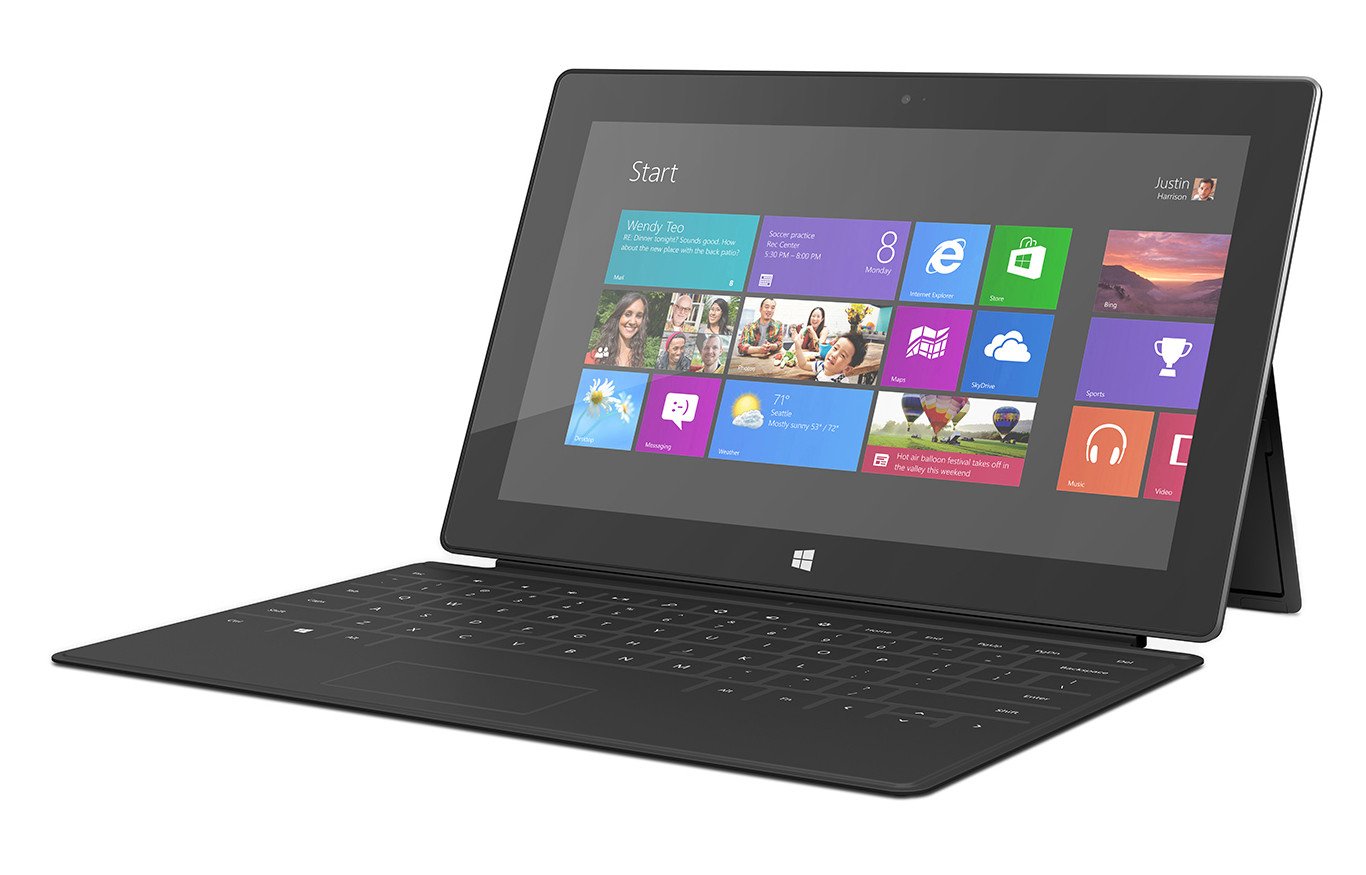
Teardown The teardown-happy folks at iFixit have taken their Torx wrenches and spudgers to Microsoft's new Surface notebook tablet, but found few surprises inside.

They did discover, however, that the Surface is more easily repairable than either the iPad 2 or its follow-on iPad 3 – aka "the new iPad". iFixit gave the Surface a repairability rating of four out of 10, handily trouncing the iPads, which received embarrassing two-out-of-10 ratings.

Not that four is all that great a score – the 7-inch Samsung Galaxy Tab, for example, was rated six out of 10, and the Samsung Galaxy Note 10.1 a full eight out of 10.

It's clear, in fact, that Microsoft wants you to know that it has no desire for you to muck about inside its new tablet. After prying open the plastic cover hiding the torx screws holding the Surface together, iFixit's tinkerers found a tamper-tattling label sealing the body together, one that breaks apart when removed.

Not that such a warning would stop any self-respecting hardware geek with a teardown in mind.

Once iFixit got the Surface open – 17 Torx screws, 10 under the kickstand and another seven under the camera-covering plastic tab – they discovered a Samsung-manufactured 7.4 V, 31.5 Watt-hour lithium ion polymer battery, which means its power source nestles comfortably between the 3.8V, 25Wh battery in the iPad 2 and the 3.7V, 42.5Wh battery in the iPad 3.

Microsoft Surface

Behold the Microsoft Surface, Redmond's latest gamble in its year of living dangerously (click to enlarge)

That battery, by the way, is glued down, but iFixit pronounced it far easier to remove than the battery cells in Apple's fondleslabs.

The 10.6-inch ClearType display, on the other hand, won't be easy to replace should you crack it. "LCD and glass are fused together and strongly adhered to the case," they explain, "increasing cost of replacement."

Attached to the Surface's logic board are two 720p cameras – one front-facing the other facing the rear – were "almost identical" in size and shape, iFixit reported in an email.

"The exclusion of a multi-megapixel rear-facing camera either means cost was a big concern," they opine, "or that Microsoft's designers don't expect you to use the Surface as your main camera. Perhaps they too realized how goofy you might look when taking pictures with a tablet.

Microsoft Surface RT - open

Just a single ribbon cable connects the two halves of the Surface, and it's easily detached (click to enlarge)

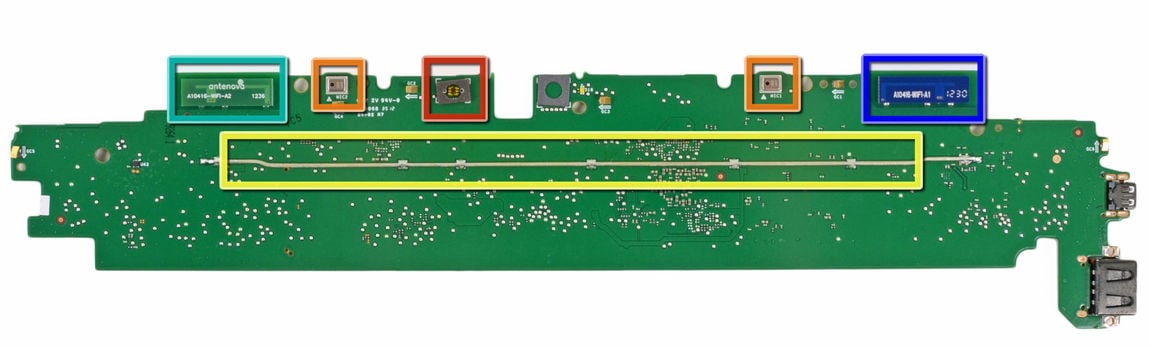
The logic board's brains are all on its top surface, with the bottom reserved for microphones, antennas, and an ambient light sensor, along with what iFixit identifies as a "precarious wire running most of its length."

As we explained when reporting iFixit's teardown of Apple's upgraded Mac mini, the tools-and-parts-and-repairs-and-teardowns folks at that website color-code their logic board chips for identification – a capability we at The Reg can't easily replicate. For the Mac mini, we attempted to describe those colors somewhat whimsically, an effort that some of our dear readers didn't appreciate.

So for the Surface teardown, we'll overcompensate with not only plainer language, but also by using Apple's Digital Color Meter app to determine iFixit's color coding's RGB values, then firing up Adobe Photoshop to convert those 0-to-255 specifications into hexadecimal values.

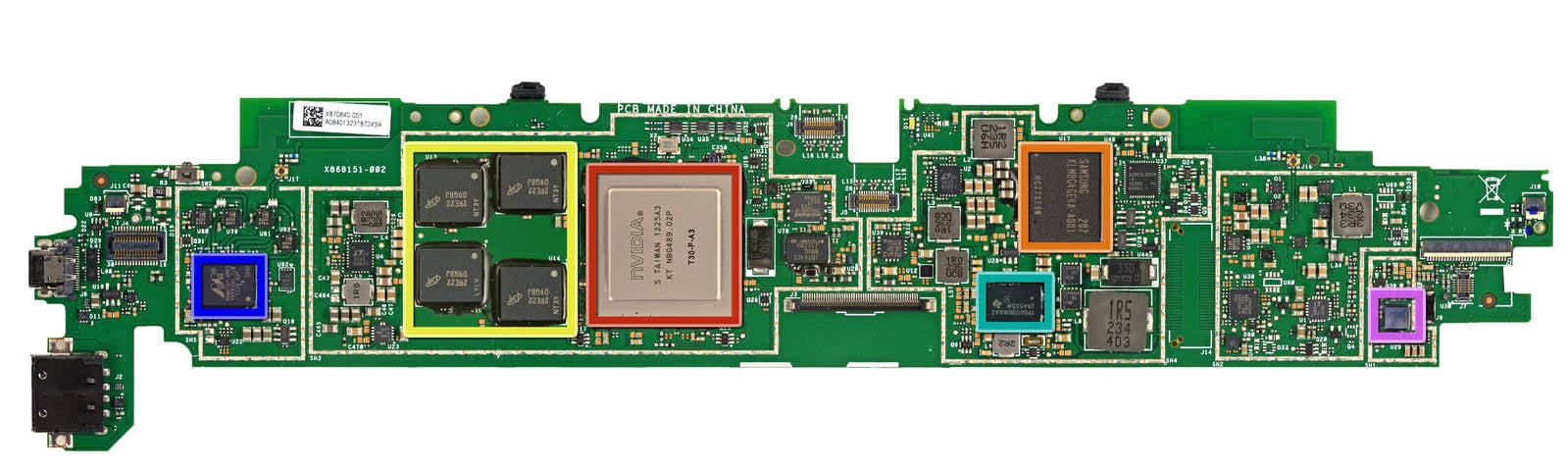
Microsoft Surface RT - logic board, top

Here's the top of the Surface's logic board (click to enlarge) ...

  • Purplish-Blue (R26, G48, B231; #1a30e7): Marvell 88W8797-BMP2 wireless MIMO SoC
  • Greenish-Yellow (R228, G230, B74; #e4e64a): Micron 2RE22 D9QBJ 2 GB DDR3 SDRAM
  • Greyish-Red (R163, G50, B25; #a33219): Nvidia quad-core 1.4GHz Tegra 3 ARM-based microprocessor
  • Bluish-Green (R97, G171, B162; #61aba2): Texas Instruments TPS659110 power management IC
  • Brownish-Orange (R198, G112, B36; #c67024): Samsung KLMBG4GE4A eMMC 32GB NAND Flash
  • Pale Violet with a Trace of Mauve (R181, G92, B227; #b55ce3): Wolfson 8962E ultra low power stereo audio codec
Microsoft Surface - logic board, bottom

... and here's its underside (click to enlarge)

  • Bluish-Green (R97, G171, B162; #61aba2): Wi-Fi antenna labled Antenova A10416-WIFI-A2
  • Brownish-Orange (R198, G112, B36; #c67024): Microphones
  • Greyish-Red (R163, G50, B25; #a33219): Ambient light sensor
  • Purplish-Blue (R26, G48, B231; #1a30e7): Wi-Fi antenna labled Antenova A10416-WIFI-A1
  • Greenish-Yellow (R228, G230, B74; #e4e64a): the aforementioned "precarious wire"
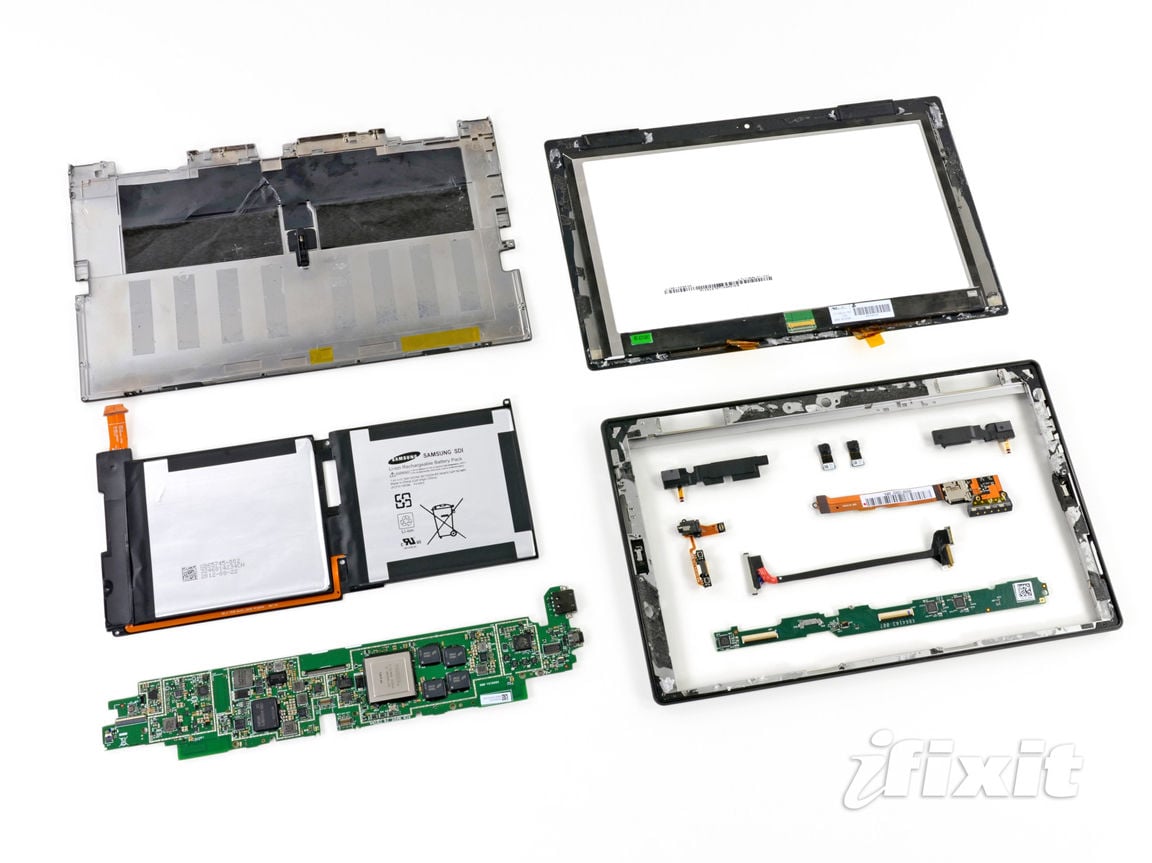
Microsoft Surface – fully disassembled

Now its time to reassemble this baker's dozen of geektastic goodies (click to enlarge)

All in all, the Surface is a rather straightforward piece of kit. To examine its innards further, you'll need to point your browser at iFixit's full teardown, replete with 42 photos and the teardowners' characteristically impudent commentary. ®

Nokia slips ahead of Windows Phone 8 launch as Samsung & Apple continue ... - ITProPortal


Smartphone shipments grew 35 per cent annually to reach nearly 162 million units in the third quarter of 2012, according to new data from research firm Strategy Analytics.

IDC reported similar numbers, estimating that smartphone vendors shipped 179.7 million units during the third quarter, up from 123.7 million units last year for 45.3 per cent year-over-year growth.

Samsung was the undisputed star of the market, shipping a record 56.9 million smartphones worldwide during the third quarter — the largest number of units ever shipped by a smartphone vendor in a single quarter — to capture a 35 per cent global share, Strategy Analytics said. Apple came in second, shipping 26.9 million smartphones worldwide to nab a 17 percent market share.

"Despite tough competition in stores and courtrooms, Samsung continued to deliver numerous hit models, from the high-end Galaxy Note phablet to the mass-market Galaxy Y," Neil Mawston, executive director at Strategy Analytics, said in a statement. "Apple had a solid quarter in the important United States market and this helped to strengthen its global performance."

The success of Samsung and Apple was not a good thing for Nokia, which slipped from the top three global smartphone rankings "for the first time in history," Neil Shah, senior analyst at Strategy Analytics, said in a statement. Nokia shipped 6.3 million smartphones worldwide, grabbing a 4 per cent market share in the third quarter, slipping from 16.8 million units and 14 per cent share a year ago.

"Nokia will need to ramp up sharply its Windows Phone volumes if it wants to recapture a top-three smartphone position in the next one to two quarters," Shah added.

ICD reported that Nokia was replaced by Blackberry maker Research in Motion. Nokia's transition from Symbian to Windows Phone-powered smartphones "has left ample opportunity for rivals to steal share away from Nokia over the past 18 months," Kevin Restivo, senior research analyst with IDC, said in a statement. Even so, there is still room in the market for Nokia and other vendors to find success, he added.

Meanwhile, the larger worldwide mobile phone market grew by 2.4 per cent over the last year, with vendors shipping a total of 444.5 million mobile phones during the period, compared to 434.1 million units last year, IDC said. The firm expects long-term mobile phone and smartphone shipments to grow even further thanks to the important role mobile phones play in people's lives.

"At the heart of mobility is communication," Ramon Llamas, research manager with IDC's mobile phone team, said in a statement. "Mobile phones and smartphones play a critical role in keeping people connected, regardless of location. In addition, their utility beyond communication — productivity, entertainment, and multimedia — continues to add to their value."

Image credit

What Microsoft should deliver at its BUILD developer conference - PCWorld (blog)

Microsoft's annual Build conference starts Tuesday, post Windows 8 launch, post Surface RT launch, and even a day after a big Windows Phone 8 event. You might think the boys in Redmond would have exhausted any shiny, new stuff by now.

Build is a developer's conference, so Microsoft will be hosting a host of sessions on how to develop applications across a range of Microsoft operating environments that keeps getting more numerous. There's Windows 8, Windows RT, Windows Phone 8 and even the Xbox 360 environment. Yet they've also played very close to the chest about the agenda, not revealing anything about the technical sessions that will be the heart of Build.

Still, there's a lot of stuff I'd like to see at Build. I'm not looking for shiny new toys, but hard information on what developers need to know, with some hints at how Microsoft sees its ecosystem of applications building. So here's my wish list, in no particular order.

Kinect for Windows

The Windows 8 touch interface integrates significant gesture recognition. But Kinect offers gestures without the need for touch (though you do need a Kinect for Windows sensor.) In addition to being a camera, Kinect also integrates depth information and has a microphone.

More than one user has complained to me that touch doesn't seem natural in a desktop PC environment, where you need to lean forward a bit and lift your hand off your mouse or keyboard to interact with your screen. Kinect, properly implemented, would still require you to lift your hands, but the gestures would be in your "user" space, without needing to break the plane between keyboard and display.

I'd love to hear and see what developers might be doing with Kinect for Windows.

Xbox updates for Smartglass integration

Smartglass, the Windows 8 app that enables two-way streaming and lets you interact with your Xbox 360 via a Windows 8 tablet or PC, is still more a promise than a reality. As it stands today, Smartglass is more a toy than a real application. It works well enough, but what it does is pretty limited. Yes, you can watch Xbox videos on your tablet, but not much else.

The promise of Smartglass will be when Xbox games can use a tablet or phone running Smartglass as a gaming accessory. Or when Smartglass on a tablet enables better integration between the PC and the console. I'm hoping we'll see some hints of what Smartglass will really do going forward.

Desktop app integration with Windows 8 apps

As it stands today, Windows 8 apps and traditional desktop applications might as well live on separate systems. Windows 8 apps have their own way of communicating with other apps through the contracts mechanism. Desktop apps use Windows APIs. Even Office 2013 runs only as a set of desktop applications.

In theory, nothing prevents a Windows 8 app from communicating with a desktop application or with the underlying Windows environment. One tool conspicuously missing, for example, is a Windows 8 app that handles file management chores. I'm hoping Microsoft will be encouraging more integration between the two parallel universes the company has built into Windows 8.

Cross platform development issues and techniques

Microsoft is trying to bootstrap itself into multiple operating environments. It's attempted this in the past, with little success. But given the increasing mobile nature of modern computing, the company can't rely on desktop Windows and desktop Office to remain competitive.

Microsoft's developers have seen some success in the past with cross platform development between the Xbox 360 and Windows PCs, in the form of PC games. As the distinction in users' minds between tablets, smart phones and PCs becoming increasingly blurry, applications that can run cross-platform will be critical to Microsoft's success. One measure of potential success will be how enthusiastically Microsoft's cadre of developers embrace the cross-platform message.

PC gaming and touch

I'm sure we'll see plenty of lightweight, Windows 8 game apps that use touch. I'm more interested in how larger, desktop enabled game titles might embrace touch. Eugen Systems created R.U.S.E.several years ago. R.U.S.E. is a real-time strategy game that enabled multi-touch in a Windows 7 enviromment. Firaxis is readying an update to Civilization V that will enable multi-touch support in the game. Hidden Path Entertainment will be adding touch to its popular Defense Grid: The Awakening tower defense game. But other game developers have been pretty quiet about Windows 8 and touch. I'd love to see how game developers might integrate touch and gestures into the PC games, particularly role-playing or action titles.

Final thoughts: applications beget users

At some level, this year's Build conference will be anticlimactic, since the event is going on after the Windows 8 launch. In some ways, though, that make Build even more important. Windows 8 is more of a known quantity among developers now.

The secret to Microsoft's success has been in vast array of large and small developers building must-have applications for the company's operating system. If developers don't embrace Windows 8 in large numbers, and instead take up other platforms, the boys in Redmond may find themselves on the margin in an era of Android, the Web and Apple. That's not a position it wants to be in. Windows 8, Windows RT and Windows 8 Phone need to appeal to developers who create the applications that users will want. What happens at Build will give us clues as to whether those developers remain loyal, or start looking for other opportunities. Either way, it's going to be an interesting conference.

Microsoft aims to herd 70% of enterprise onto Windows 7 by mid-2013 - Register

Exclusive Microsoft has set an aggressive target of 70 per cent of enterprise PCs running Windows 7 by the summer of 2013.

The Reg has learned from sources close to Microsoft that the goal set by Redmond HQ is for an additional 20 per cent of enterprise PCs to move to Windows 7 by the end of its current fiscal year – on 30 June 2013. That would build on the disputed 50 per cent of enterprise PCs that Microsoft claimed during the summer of this year that were on Windows 7.

Windows and Windows Live chief financial officer and marketing officer Tami Reller claimed the 50 per cent stat in July, at Microsoft's annual global partner conference.

It looks like the kinds of organisations Microsoft's field must target during 2013 will be those running some of the biggest and hardest application migration projects – the kinds Microsoft shied away from last year and which couldn't be included in the 50 per cent number.

And Microsoft's field must operate in an environment where Redmond's corporate attention is 100-per-cent focused on Windows 8 rather than Windows 7.

A source close to Microsoft's field told The Reg: "Microsoft doesn't have a coordinated worldwide effort to get Windows 7 deployed."

The Reg asked Microsoft if we could speak to somebody leading the 70 per cent charge, to discuss what strategy is planned and how last year's 50-per-cent stat was compiled. However, a Microsoft spokesperson said the company was not able to comment.

Whether Microsoft can hit the new 70 per cent target is questionable, because the baseline 50 per cent stat Reller gave is in dispute and is increasingly being discredited.

Browser-management startup Browsium questioned the 50 per cent stat at the time in a blog, and claimed Microsoft had included non-enterprise operations in its numbers. Browsium claimed at the time that Microsoft had thrown in small and medium businesses and education users, and those running apps that are "easy" to migrate.

Browsium said 80 per cent of big companies – banks, healthcare and insurance companies, and government organisations with 10,000 or more PCs – are still clinging to Windows XP, with just 20 per cent on Windows 7. The company called Microsoft's numbers "optimistic."

And Microsoft partners The Reg has spoken to are telling us that only now – three years after Windows 7 launched – are they experiencing a rush of work as customers jump off Windows XP.

BDNA this month told us it's working on five of the seven largest Windows migrations in the US with two customers on 450,000 and 250,000 PCs each, all running Windows XP. The projects are new, with the 250,000 migration, a financial institution, only two-and-a-half months into its life.

Desktop management specialist SmartDeploy told us of another major government customer with hundreds of thousands of PCs also only now going to Windows 7 from Windows XP.

Should Microsoft's field fail to hit the 70 per cent target, then it will be marked down under chief-operating-officer Kevin Turner's infamous red, amber and green traffic light system, so there's is a huge incentive for employees to push Windows 7 upgrades hard and fast.

There's also another incentive, and that's the date for the end-of-support date for Windows X: 8 April, 2014.

Organisations still using Windows XP after that April date will be left naked by Microsoft - they will no longer receive code updates or security fixes, with Microsoft so far holding out against extending the deadline. Instead, Microsoft can offer individual, paid support re-deploying engineers and dedicating them to the customer in question – but it comes at a price.

Extended support is a pain for Microsoft, because it diverts people from building new versions of Windows. It's a problem for customers, too, because it's expensive.

Gartner in May said you'd pay $200,000 for the first year if you are on Microsoft's Software Assurance and $500,000 if you aren't on SA.

One Microsoft partner told us "there's no chance" large enterprise customers – those with 500,000 PCs or more – would migrate more than half of their PCs to Windows 7 by the April 2014 deadline.

"It's too hard, and the economy sucks and people aren't throw enough money at it," the partner said.

The difficult part is moving in-house apps and apps dependent on the Windows XP browsers, IE6 and IE7, to the browser in Windows 7. It's these kinds of customers that have not been included in the migrations that Reller was boasting about during the summer.

Aaron Suzuki, SmartDeploy chief executive, told us he reckoned customers that are big enough – those with hundreds of thousands of PCs – could eventually force Microsoft to support them if they are still on Windows XP after April 2014.

"People are seeming not that anxious to get off Windows XP," Suzuki told us. "Customers are content to run multiple generations of operating systems concurrently because of the application dependencies."

The Reg asked Microsoft what plans it is drawing up to support customers who miss the 8 April 2014 date, whether it would extend support and how much it would charge organisations.

A spokesperson instead referred us to Microsoft's support lifecycle policy FAQ here.

The policy states: "Microsoft offers custom support relationships that go beyond the Extended Support phase. These custom support relationships may include assisted support and hotfix support, and may extend beyond 10 years from the date a product becomes generally available.

"Strategic Microsoft partners may also offer support beyond the Extended Support phase. Customers and partners can contact their account team or their local Microsoft representative for more information." ®